

Can Reclaimed Slates Be Reused?
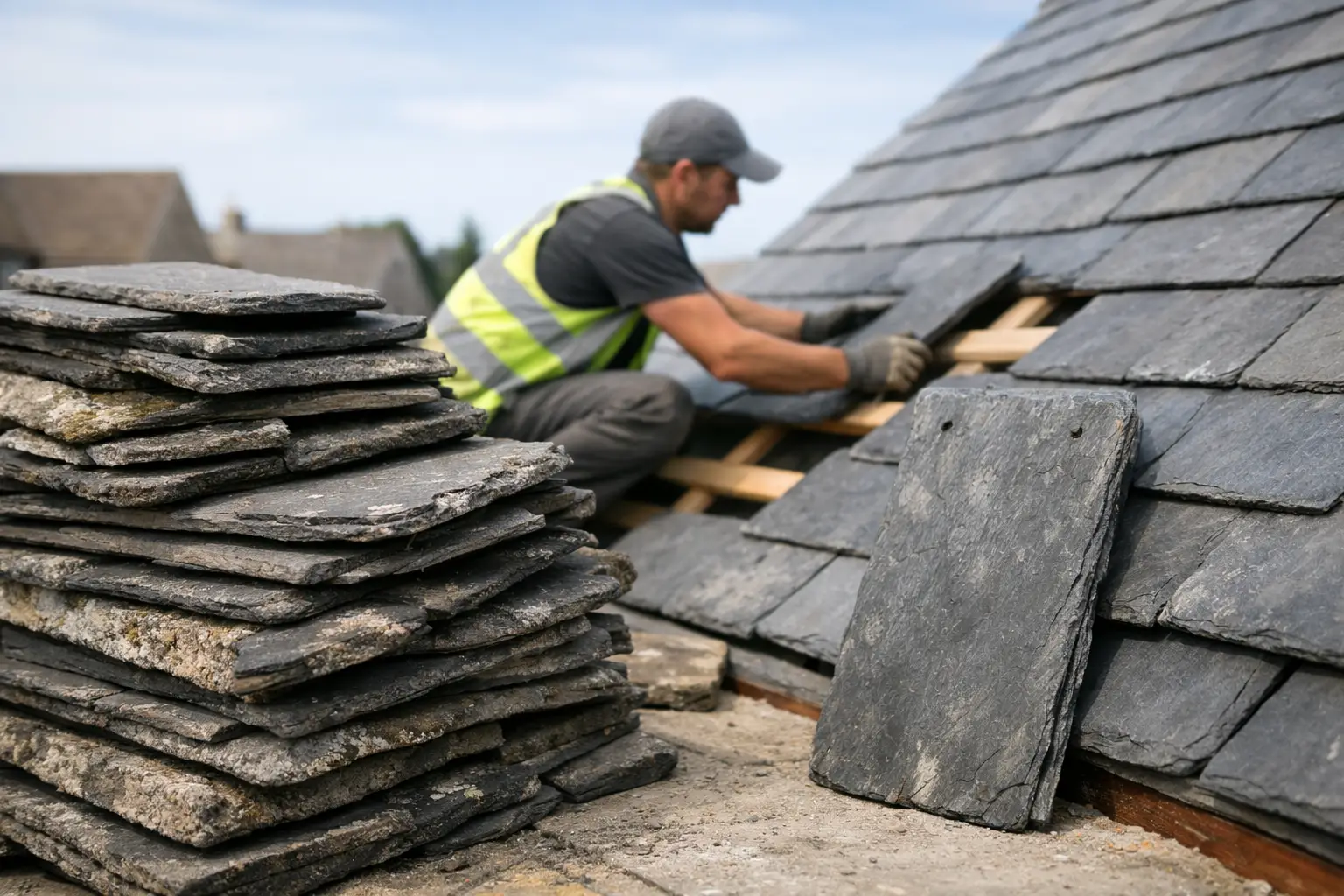
A roof stripped from a Victorian terrace or stone-built farmhouse often still has plenty of life left in it. That is why a common question on repair and restoration work is: can reclaimed slates be reused? In many cases, yes – but only if the slates are sorted properly, checked for condition, and matched to the job they are going back onto.
For roofers, builders and property owners, the real issue is not whether a slate is old. It is whether it remains sound, serviceable and compatible with the existing roof. Good reclaimed slate can deliver the right appearance, the right weathering, and long-term performance that new alternatives may not always replicate, especially on period properties.
Can reclaimed slates be reused on any roof?
Not on every roof, and not without inspection. Reclaimed slates can be reused successfully on repairs, partial reroofs and full reroofing projects, but their suitability depends on the slate type, its remaining life, and the roof specification.
A durable slate that has come off a building because of structural work or redevelopment may still be perfectly fit for relaying. By contrast, slates removed from a failing roof after decades of nail sickness, heavy delamination or repeated patch repairs may not justify the labour cost of re-use.
This is where quality control matters. Reclaimed slate is only worth using when it has been graded, checked and separated into usable stock. On heritage jobs, that process is often the difference between a sound repair and a mismatch that stands out from street level.
What makes a reclaimed slate reusable?
The short answer is condition. A reusable reclaimed slate should still be structurally sound, hold a fixing properly, and shed water as intended once relaid.
The first point to assess is whether the slate itself remains intact. Surface weathering is normal and often desirable on older roofs, but excessive flaking, softness or lamination is a warning sign. If the slate is splitting into layers, it is near the end of its life and should not go back on a roof.
Fixing holes are another key check. Many reclaimed slates are redrilled or sorted according to how they were originally fixed. If the nail holes are blown, cracked or too close to a weakened edge, the slate becomes unreliable. A slate may look acceptable when stacked but fail quickly once handled on site.
Thickness and dimensional consistency also matter. A batch with wide variation in size, thickness and coursing can still be usable, especially on traditional roofs, but it needs to suit the roof build-up and laying pattern. Random stock can work well on some heritage projects, while more regular stock is usually better for straightforward repairs or larger reroofing jobs.
Why reclaimed slate is often the right choice
On period buildings, visual match is usually the biggest reason reclaimed slate is specified. New slate can be an excellent roofing material, but if the existing roof has decades of weathering, variation in tone and local character, a reclaimed match is often the only practical way to preserve the roofline properly.
That applies whether you are replacing a few storm-damaged slates or carrying out a larger section repair. A reclaimed Welsh slate, Burlington slate or Yorkshire stone slate can sit far more naturally alongside original material than a new substitute with a different finish, edge detail or thickness.
There is also the sustainability case, which is hard to ignore. Reusing a quality roofing material that still has serviceable life left reduces waste and lowers the demand for newly quarried product. For many clients, especially those balancing conservation and environmental considerations, that is a genuine advantage rather than a marketing add-on.
Cost can be part of the equation too, though it is not always as simple as reclaimed meaning cheaper. High-quality reclaimed slate, particularly sought-after heritage types, can command strong prices because supply is finite and demand is consistent. The value lies in compatibility and performance, not just initial material cost.
When reclaimed slates should not be reused
There are cases where reuse is the wrong decision. If slates have widespread delamination, severe breakage or evidence of exhausted lifespan, salvaging them may create more problems than it solves. Labour on roofing is expensive, and fitting poor stock onto a roof is a false economy.
The same applies where too many slates have inconsistent dimensions for the intended setting out. On some traditional roofs, variation is expected. On others, especially where the roof has a more regular gauge, poor consistency can slow the job and affect appearance.
It also depends on the roof pitch, exposure and specification. A marginal slate on a sheltered outbuilding may be one thing. The same slate on a steep, exposed main roof in poor weather conditions is another. Good roofing practice means judging the material against the actual demands of the building.
How reclaimed slates are checked before reuse
Professional sorting is not optional with reclaimed slate. Before slates are sold or relaid, they should be inspected individually or by grade for size, thickness and condition. Any broken, laminated or understrength pieces need to be removed from the usable batch.
In practice, that often includes checking edges for damage, testing the body of the slate for weakness, and assessing whether it can be fixed securely. Trade buyers will also want clarity on nominal size, actual coverage, and whether the stock is regular or mixed.
This is especially important when matching an existing roof. A reclaimed slate does not just need to be sound – it needs to be the right type, profile and appearance for the building. On listed or heritage-sensitive properties, getting that wrong can undermine the whole repair.
Reusing reclaimed slates for repairs versus full reroofs
Small repairs are usually where reclaimed slate proves its value fastest. If only a section of roof has failed, using matching reclaimed slates can maintain the original character without forcing an obvious patch of new material into the slope.
For full reroofs, the decision takes more planning. A complete reclaimed slate reroof can work extremely well, but the stock needs to be sufficient in volume and consistent enough for the area involved. That is why larger projects often depend on a specialist supplier with the inventory to provide either a close match or a quantity run from the same batch.
This is one of the practical differences between buying a handful of slates from an ad hoc source and buying from a specialist stockholder. Consistency, grading and availability matter far more once the job moves beyond a minor repair.
Matching matters as much as condition
A reusable slate still needs to be the right slate. Welsh slate, Burlington slate, Yorkshire stone slate and clay-based roof coverings all have distinct characteristics. Mixing the wrong materials can create visual inconsistency, but it can also cause laying complications if thickness, lap or headlap assumptions change.
For contractors, this is where accurate identification saves time. For homeowners, it usually means getting advice before ordering on appearance alone. A slate that looks close enough in a photograph may be wrong in size, wrong in thickness or simply wrong for the age and style of the roof.
Specialist suppliers such as ReclaimedRoofSlates.com work with this every day because sourcing the right reclaimed material is rarely just about colour. It is about compatibility across dimensions, geology, weathering and roof detail.
Are reclaimed slates worth the effort?
Where the slate is sound and the match is right, absolutely. Reclaimed slates allow repairs to blend properly, support heritage standards, and extend the life of existing roofs with materials that already suit the building.
The trade-off is that reclaimed stock needs proper selection. You cannot assume every old slate is reusable, and you cannot treat mixed salvage as a guaranteed roofing product. The quality of the sorting process is what makes reclaimed slate a dependable option rather than a gamble.
If you are planning a repair or reroof, the sensible starting point is to assess the roof, identify the slate type, and work out whether you need a visual match, a quantity supply, or both. When that is done properly, reclaimed slate is not just reusable – it is often the best fit for the job.
A good roof repair is not about using old materials for the sake of it. It is about putting the right slates back where they belong, with enough life left in them to do the job properly.

