

Natural Slate Versus Fibre Cement Roofs Compared
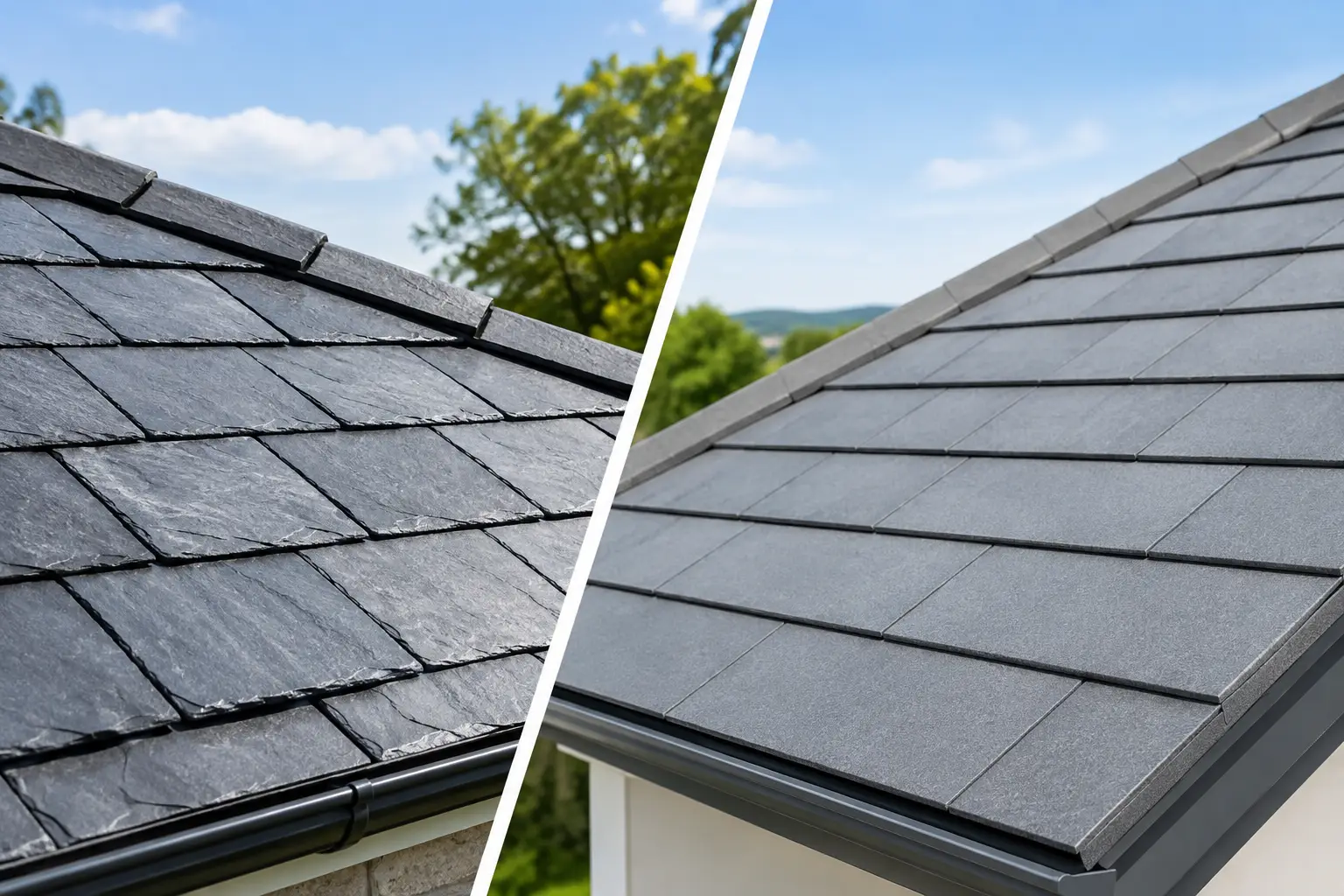
A roof repair can look straightforward until the replacement material is laid beside the original covering. The choice between natural slate versus fibre cement is not simply a question of price. It affects the roof’s appearance, lifespan, loading, repairability and, on period properties, whether the finished work respects the building at all.
For a modern extension or a budget-led new build, fibre cement can be a sensible and serviceable roofing material. For a listed building, traditional cottage, Victorian terrace or established slate roof, natural slate is often the only material that will give a convincing and lasting match. The right answer depends on the roof in front of you, not a generic specification.
Natural Slate Versus Fibre Cement: The Main Difference
Natural slate is a quarried stone, split along its natural grain into individual roofing slates. Each piece has subtle variation in texture, thickness and tone. Welsh, Burlington and other quality slates are valued because they can remain in service for generations when they are correctly fixed and maintained.
Fibre cement slates are factory-made products formed from cement, fibres and additives. Modern fibre cement roofing is asbestos-free, lightweight and available in consistent sizes and colours. It is designed to provide a neat, uniform slate-like finish at a lower initial material cost.
That distinction matters most on visible roof slopes. Natural slate has depth, a riven surface and slight variation that changes with the weather and light. Fibre cement has a flatter, more regular appearance. From street level it can look tidy and appropriate on the right building, but it does not develop the same character as stone slate.
Appearance and Heritage Compatibility
If you are repairing an existing natural slate roof, the priority is usually continuity. A few fibre cement replacements in a field of weathered slate can stand out through their uniform edges, colour and surface finish. This is particularly noticeable after rain, when natural slate darkens and reflects light differently.
Reclaimed natural slate offers a practical route to a closer match. It has already weathered, so its colour and texture tend to sit more naturally beside an older roof than a newly manufactured alternative. The exact source, size, thickness and headlap still need checking. A Welsh slate, for example, is not automatically a match for a Burlington or imported slate roof simply because both are grey.
Conservation officers may also expect like-for-like materials on listed buildings or within sensitive conservation areas. Requirements vary by property and local authority, but changing from slate to fibre cement without checking can create planning or heritage problems. Even where approval is not required, a poor visual match can reduce the quality and perceived value of a period property.
For a contemporary outbuilding, garage, agricultural structure or rear elevation with no heritage requirement, the clean consistency of fibre cement may be entirely suitable. It should be chosen as a deliberate finish, rather than presented as an identical substitute for natural slate.
Weight, Roof Structure and Fixing Details
Fibre cement is generally lighter than natural slate, which can make it useful where the roof structure has limited load capacity. This does not mean it can be installed without proper design. Battens, rafters, underlay, fixings, roof pitch and wind exposure all need to meet the manufacturer’s specification and current roofing practice.
Natural slate adds more weight, especially where thicker or larger slates are used. Before re-roofing a property that previously carried a lightweight covering, a competent roofer should assess whether the structure is suitable. On most older slate roofs, however, the supporting structure was designed for slate and the question is more likely to be the condition of timbers, battens and fixings.
Slate roofing also relies on correct grading and laying. Slates are normally sorted by thickness before fixing, with thicker pieces used lower down the roof where appropriate. Headlap, sidelap and nail position must suit the roof pitch and exposure. These details determine whether water is shed correctly and whether the roof looks properly coursed.
Fibre cement benefits from its regularity: dimensions are consistent, setting out is predictable and cutting is straightforward with suitable equipment. Natural slate demands more judgement on site, particularly when working with reclaimed material. That extra care is part of the value, not wasted time.
Lifespan and Whole-Life Value
A quality natural slate roof can outlast several cycles of cheaper roof coverings. The stone itself is exceptionally durable; failures are more commonly linked to corroded nails, poor fixing, damaged flashings or neglected roof details than to the slate wearing out. Individual broken or slipped slates can often be replaced without disturbing a large area.
Fibre cement has a shorter expected service life than high-quality natural slate, although its actual performance depends heavily on the product, exposure and installation. It can become brittle with age, and its surface finish may weather or fade differently across a roof. Replacement units may also be difficult to match if a product line or colour is later changed.
Initial cost should therefore be considered alongside future work. Fibre cement is often cheaper to buy and lighter to handle. Natural slate has a higher upfront cost, particularly where specialist sorting, matching and skilled installation are needed, but it can represent better value over the life of the roof. This is especially true for properties where authentic materials protect character and resale appeal.
Sustainability: Reclaimed Slate Has a Strong Case
Natural slate is a long-life material, but reclaimed slate adds another advantage: it keeps usable stone in circulation. When slates are carefully recovered, inspected and sorted, they can be reused on repairs and complete roofing projects instead of being discarded.
That matters when only a small quantity is needed. Replacing a few storm-damaged slates with compatible reclaimed pieces avoids stripping a sound roof simply because new replacements look wrong. It also preserves the visual history of the building.
Fibre cement can be a lower-impact option than some short-life roofing products, particularly because it is lighter to transport and uses less natural stone. Yet it remains a manufactured material with a finite service life. For projects where original slate can be retained or reclaimed slate can be matched, reuse is usually the more convincing environmental and architectural choice.
Choosing the Right Material for Your Roof
Natural slate is normally the stronger choice when repairing a traditional slate roof, working on a listed or heritage property, or specifying a roof intended to last for decades with proper maintenance. It is also the right direction where depth of colour, riven texture and a genuine stone finish are central to the project.
Fibre cement is worth considering where weight is critical, the building is contemporary, the budget is tightly controlled, or a uniform manufactured appearance is acceptable. It can perform well when the complete system is specified correctly and installed to the manufacturer’s requirements.
The difficult cases are partial repairs. Do not select a replacement slate from a photograph alone. Measure the existing slate length and width, note its thickness, identify the prevailing colour, check the headlap and establish whether it is nailed, hooked or fixed by another method. A nominally similar slate can be wrong in several important ways.
For trade repairs and period-property work, it is often more effective to source a small batch of properly matched reclaimed slates than to compromise the whole elevation with an obvious alternative. ReclaimedRoofSlates.com can help identify suitable reclaimed options alongside the battens, fixings, lead and roofing essentials needed to complete the job properly.
A roof is most convincing when the material suits the building and the details are resolved before work begins. Take a sample, check the existing roof closely and choose the covering you will still be comfortable looking at after the scaffold has come down.

