

How to Choose Slate Hooks for a Lasting Roof
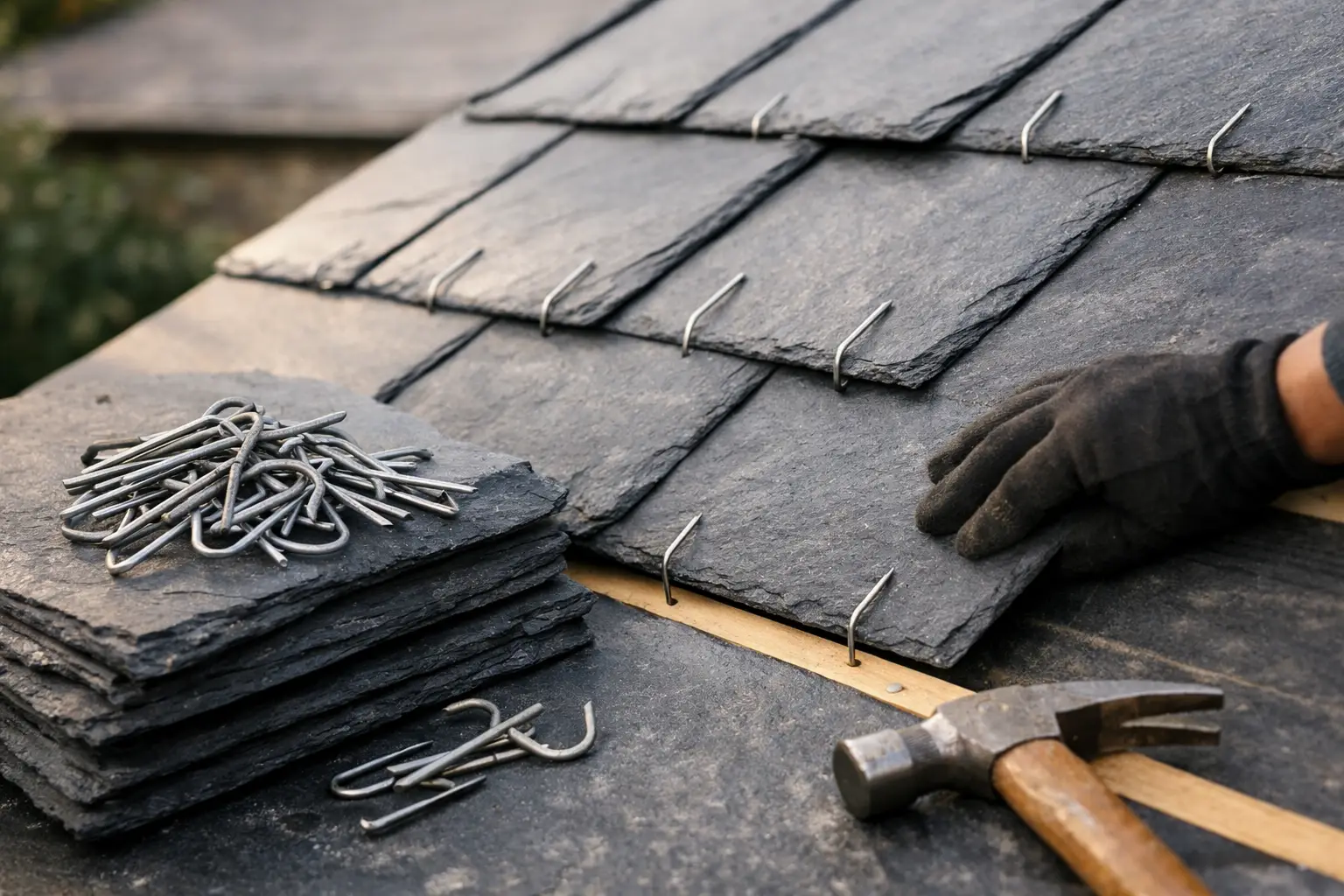
A replacement slate can be an excellent visual match and still fail early if it is held by the wrong hook. Hooks that are too short may not achieve a secure fixing into the batten; hooks that are too large, too stiff or poorly matched to the slate can cause cracking, poor alignment and an untidy finish. Knowing how to choose slate hooks is therefore as much about the existing roof construction as it is about the slate itself.
Slate hooks are particularly useful on repairs, heritage work and roofs where preserving sound surrounding slates matters. Unlike traditional nail fixing, a hook can often secure a replacement slate without disturbing a large area of roof covering. The right choice must suit the slate thickness, batten, pitch, exposure and the fixing specification for the job.
Start with the roof, not the hook
Before ordering hooks, establish exactly what is on the roof. Identify whether the covering is Welsh slate, Burlington slate, a Spanish or Brazilian natural slate, or a man-made slate. Reclaimed slates can vary considerably in thickness, even within the same roof slope, so measure several sound examples rather than relying on one piece.
Check the slate width and length, the headlap and the gauge already used. These dimensions affect where the hook will sit and whether the finished repair will follow the existing coursing. On an older roof, the batten size and condition also deserve close attention. A hook can only perform properly when it is driven into sound timber with adequate purchase.
For a full reroof, work from the slate manufacturer’s fixing guidance and the roof design. For a local repair, take the existing roof as the starting point, but do not copy a poor or corroded fixing detail simply because it is already there.
Choose a hook length that reaches sound timber
Hook length is the first practical decision. The fixing leg must pass through the slate arrangement and achieve sufficient penetration into the batten, while the formed hook must support the lower edge of the slate securely without forcing it upwards.
A roofer should assess the thickness of the replacement slate, the thickness of the slate below it, the batten depth and the required embedment. On a repair, look at the original fixing pattern where it is visible, but confirm that the batten is still solid before assuming the same hook length is suitable. Decayed battens, split timber or previous nail holes may require a more involved repair rather than a longer hook.
Do not select hooks only by the visible slate size. A large, thick reclaimed slate on a substantial batten will usually need a different hook from a thin slate used on a smaller repair. The hook should sit naturally against the slate edge. If it has to be pulled tight or bent excessively to hold the slate in place, the selection or fitting method is wrong.
Avoid a proud or over-tight finish
A correctly fitted slate should lie flat in line with the surrounding course. If the hook leaves the slate standing proud, water can be driven beneath the covering and the repair will be obvious from ground level. Over-tightening is equally damaging, particularly with weathered reclaimed slates that may have thin edges or old nail holes.
The hook is there to retain the slate, not clamp it rigidly to the roof. Allow for the normal tolerances of a natural material and ensure the slate is supported as intended by the course below.
Match the hook material to the roof environment
For most modern slate-hook work, stainless steel is the dependable choice. It offers strong resistance to corrosion and is suitable for long-term use where the specified grade suits the roof environment. This matters because a fixing is difficult and costly to replace once the roof has weathered in.
Coastal locations, exposed hillsides and areas with higher airborne pollution demand particular care. Salt-laden air can shorten the life of unsuitable metals, and fixing corrosion often shows itself long before the slate has reached the end of its service life. A roof in a sheltered town setting and a roof on the Yorkshire coast should not automatically receive the same fixing specification.
Copper hooks are used on certain heritage schemes and can provide an appropriate long-life fixing where the project specification calls for them. They are normally a higher-cost option and should be considered alongside any leadwork, copper detailing or other metal components on the roof. Mixing metals without thought can create avoidable compatibility issues.
Consider wire diameter and slate weight
Hook diameter affects strength, handling and the way the hook bears against the slate. Heavier slates, longer slates and more exposed roofs may require a stronger fixing arrangement than a small, thin slate on a sheltered elevation. The correct diameter should follow the slate and roof fixing specification rather than guesswork.
A heavier hook is not always better. On a delicate reclaimed slate, an overly rigid wire can make fitting less forgiving and may concentrate pressure at the lower edge. Conversely, a light hook may not be suitable where wind uplift and slate weight place greater demand on the fixing.
This is one reason reclaimed work benefits from sorting slates before installation. Grouping material by thickness and size helps maintain even courses and allows the fixing approach to be planned properly. A mixed load of reclaimed slates may be ideal for a traditional roof, but it should not be treated as if every piece has identical dimensions.
Account for pitch, exposure and wind uplift
Roof pitch and exposure affect every fixing decision. A low-pitched roof, an open rural site, a tall building or a roof close to the coast may need more careful fixing design than a modest roof in a sheltered position. Wind does not act evenly across a roof either: eaves, verges, ridges and corners can be subject to greater uplift.
Hooks may be used as part of the main fixing method or as a repair solution, depending on the slate system and specification. In some situations, hook fixing is not appropriate on its own. Nail-fixed slates, clips or supplementary fixings may be required to meet the roof design, local exposure conditions and the relevant British Standards.
For trade work, confirm the fixing schedule before materials are delivered to site. For homeowners, this is a worthwhile conversation to have with the roofer before ordering slates and accessories. Saving a small amount on the wrong hooks makes little sense if the roof needs opening up again after the first severe weather.
How to choose slate hooks for repair work
Repairs present a different set of challenges from new work. The objective is usually to replace a slipped, broken or missing slate while keeping the original roof as intact as possible. Begin by measuring the opening and comparing the replacement slate with its neighbours for length, width, thickness, colour and surface character.
The hook must fit the repair detail without damaging adjoining slates. Lift surrounding slates only as far as necessary, clear out failed fixing remnants where possible and check that the batten has not deteriorated. If the failure was caused by timber decay, repeated movement or widespread fixing corrosion, replacing one slate will only conceal the larger problem.
On a period property, visual continuity is as valuable as the mechanical fixing. A suitable reclaimed slate with the right hook detail can blend into an established roof far better than a new slate with a noticeably different texture or sheen. ReclaimedRoofSlates.com supplies reclaimed material and complementary roofing essentials so repairs can be specified as a complete job, rather than as a slate alone.
Check the practical details before ordering
Before placing an order, have the slate type, slate dimensions, approximate thickness, batten dimensions and roof location to hand. Confirm whether the hooks are for a small repair or a larger roof area, and whether there is a written fixing specification from an architect, surveyor or slate manufacturer.
Also consider access and working conditions. Hook-fixed repairs can be efficient, but they still require safe roof access, suitable PPE and careful handling of brittle material. Never use a hook as a shortcut around an unsafe or failing roof structure.
The best slate hook is the one that suits the actual roof build-up, exposure and slate, not simply the one that looks closest to the existing fixing. Take accurate measurements, inspect the battens and choose corrosion-resistant fixings with the expected life of the roof in mind. That care helps a repaired or renewed slate roof remain weather-tight while retaining the character that made the original covering worth saving.

