

Roof Slate Hooks vs Nails: Which Fixing Fits?
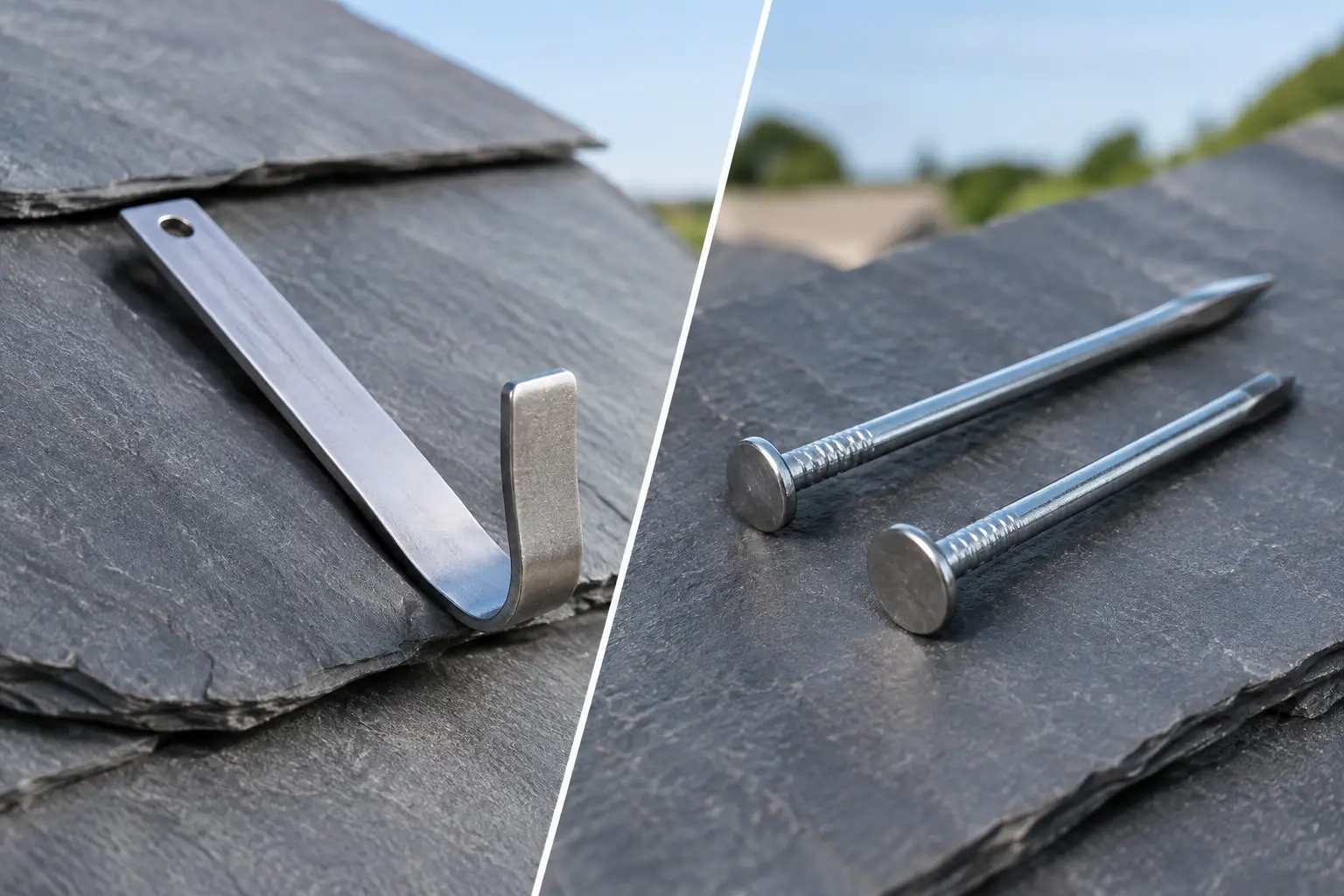
A sound slate roof is only as dependable as the fixing beneath it. When weighing up roof slate hooks vs nails, the right answer is not simply whichever is quicker or cheaper. Slate type, roof pitch, exposure, batten condition, planning requirements and the nature of the repair all affect the choice.
For a full re-roof, traditional nailing remains the usual method for natural slate in the UK. For repairs, awkward replacement work and certain exposed details, slate hooks can be an extremely useful alternative. Knowing where each fixing performs best helps avoid cracked slates, uneven courses and costly call-backs.
Roof Slate Hooks vs Nails: The Core Difference
Nailed slates are fixed through pre-punched or drilled holes near the head of each slate. The nail secures the slate to the batten while the course above covers the fixing. This is the established method seen across traditional Welsh slate roofs, Burlington slate roofs and many period properties throughout the country.
Slate hooks work differently. Each hook is fixed to the batten, normally at the head, and its curved lower section holds the tail of the slate in place. Rather than driving a nail through the slate itself, the slate sits beneath the hook. Hooks are generally made from stainless steel or copper, chosen to provide suitable corrosion resistance over the life of the roof.
Both methods can deliver a long-lasting roof when specified and fitted correctly. The practical difference is that nails rely on sound fixing holes in the slate, while hooks hold the slate at its lower edge. That distinction matters most when working with reclaimed slates, where existing holes, thickness variation and the need to preserve original material are common considerations.
Why Nails Remain the Traditional Choice
Nails suit most new natural slate installations because they create a clean, regular finish and work efficiently when the slates are graded, holed and laid to a consistent gauge. On a properly designed roof, two fixings per slate are typically used, with the exact nail type and length selected for the slate thickness, batten depth and roof specification.
Copper nails have a long-established place in quality slate work and are particularly appropriate for heritage applications. Stainless steel nails are also widely used and offer strong corrosion resistance. The fixing must be compatible with the slate, roof environment and any nearby metals. A fixing that corrodes prematurely can fail long before a good natural slate reaches the end of its serviceable life.
The key to nailing is restraint. A nail should hold the slate without clamping it tightly to the batten. Overdriven nails place pressure on the slate and can cause cracking, particularly with thinner material or reclaimed slates that have already seen decades of weathering. Slates need a small amount of freedom to accommodate movement and avoid stress at the nail hole.
Nails are often the most convincing choice where visual authenticity is central to the job. On listed buildings, conservation projects and carefully restored period roofs, traditional nailing may be expected unless there is a clear practical reason to use another method.
When nails are most suitable
Nailing is generally the strongest starting point for complete re-roofs, regular courses of sound slate, and projects where the roof must closely replicate historic fixing practice. It is also a sensible choice where the slates have properly positioned holes and access allows the roofer to fix each course in the normal sequence.
That said, traditional does not mean automatic. A roof in a severe coastal or upland exposure zone may need a more detailed fixing specification, regardless of whether nails are used. Wind loading, pitch, location and building height should always be considered before relying on a standard approach.
Where Slate Hooks Earn Their Place
Slate hooks are especially valuable in repair work. If a damaged slate must be replaced within an existing roof, driving nails through the replacement can be difficult because the course above is already in place. A hook allows the replacement slate to be positioned without disturbing a larger area of sound roofing.
This makes hooks useful when matching a small number of reclaimed slates into an older roof. A carefully selected replacement can preserve the roof’s colour, texture and weathered character, while the hook provides a practical means of securing it. For homeowners, this can prevent a minor repair becoming an unnecessarily extensive strip-and-relay job.
Hooks can also help where a reclaimed slate has imperfect or unsuitable nail holes. Reclaimed material should always be checked for soundness, thickness, size and condition, but a hook may allow a usable slate to be retained where re-holing would compromise it or create an untidy result.
The lower part of the hook remains visible at the slate tail, so appearance needs consideration. On many roofs it is discreet, especially once the metal has weathered, but it will not replicate the uninterrupted look of a traditionally nailed roof. On a highly prominent front elevation or a sensitive heritage project, that small visual difference may be enough to favour nails.
The limitations of hooks
Hooks are not a shortcut for poor workmanship or unsuitable slates. They need to be the correct size for the slate thickness and intended lap, and they must be fixed securely into sound battens. A poorly chosen hook can sit proud, distort the course or leave the slate insufficiently restrained.
They can also add material cost on a larger roof. For one or two repairs, that cost is usually modest compared with the labour saved. Across a full roof, however, the price of individual hooks and the time needed to lay them may make traditional nailing the more economical option.
Most importantly, hooks do not remove the need for proper roof design. Underlay, battens, headlap, side lap, verge details and drainage all still need to be right. A hook only secures the slate. It cannot compensate for a roof that has been set out incorrectly.
Wind Resistance, Pitch and Exposure
Wind uplift is one of the main reasons to treat fixing choice as a specification issue rather than a matter of preference. Slates at eaves, verges, ridges, abutments and other perimeter zones can be subject to greater wind forces than those in the main roof area. Higher buildings and exposed sites require particular care.
A nail-fixed roof can perform exceptionally well in exposed conditions when the fixing pattern, lap and materials have been designed accordingly. Equally, a hook system may offer useful additional restraint in certain applications, especially for replacement slates. Neither should be assumed to be universally better for wind resistance without considering the roof as a whole.
Roof pitch also changes the equation. Lower pitches usually require greater headlap to shed water effectively, which alters the visible length of each slate and the batten gauge. The selected hook or nail arrangement must work with that layout. Natural slate is forgiving in appearance, but it is not forgiving of poor gauging.
For exposed or unusual roofs, follow the project specification and the relevant fixing guidance rather than relying on what was used on a sheltered domestic repair. This is particularly important where reclaimed slates of mixed origin are being introduced to an existing covering.
Choosing Fixings for Reclaimed Slate Repairs
Reclaimed slate brings character that new material cannot always match, but it requires careful selection. Before choosing hooks or nails, inspect the replacement slate for lamination, edge damage, excessive wear around holes and signs of weakness. The aim is not merely to make a slate fit the opening. It is to install a piece that will weather at a similar rate to the surrounding roof.
If the replacement slate is sound and has usable holes in the right position, nailing may give the most traditional result. If access is restricted by the existing courses, or the holes are not suitable, a properly sized slate hook is often the sensible repair method.
Avoid trying to force a modern, uniform fixing approach onto irregular historic material. Reclaimed Welsh, Burlington and Yorkshire stone slates can vary in thickness, texture and dimensions. Sorting and grading before installation is essential, and the fixing should suit the slate rather than the other way around.
Cost, Longevity and Practical Value
The lowest initial cost is not always the best value. A cheap galvanised fixing may appear attractive, but if it deteriorates before the slates themselves, the roof can develop slipped or loose slates long before it should. High-quality non-ferrous or corrosion-resistant fixings are a small but critical part of a durable roof covering.
Nails are usually more cost-effective for a complete, accessible roof installation. Hooks often offer better value for isolated repairs because they reduce disruption and preserve neighbouring slates. Labour, access equipment and the risk of damaging sound original material should all be included when comparing costs.
For heritage properties, the visual and practical value of keeping an established roof intact can outweigh the marginal cost of the preferred fixing. A well-matched reclaimed replacement, securely fitted with an appropriate hook, is often a far better outcome than replacing a broad area with material that does not blend in.
The best fixing is the one that respects the slate, suits the roof design and can be expected to last alongside the covering. For a full traditional re-roof, that will often mean correctly specified nails. For a careful repair using hard-to-match reclaimed material, a slate hook may be the neatest and most economical way to keep a good roof doing its job.

