

Low Carbon Slate Supply for Heritage Roofs
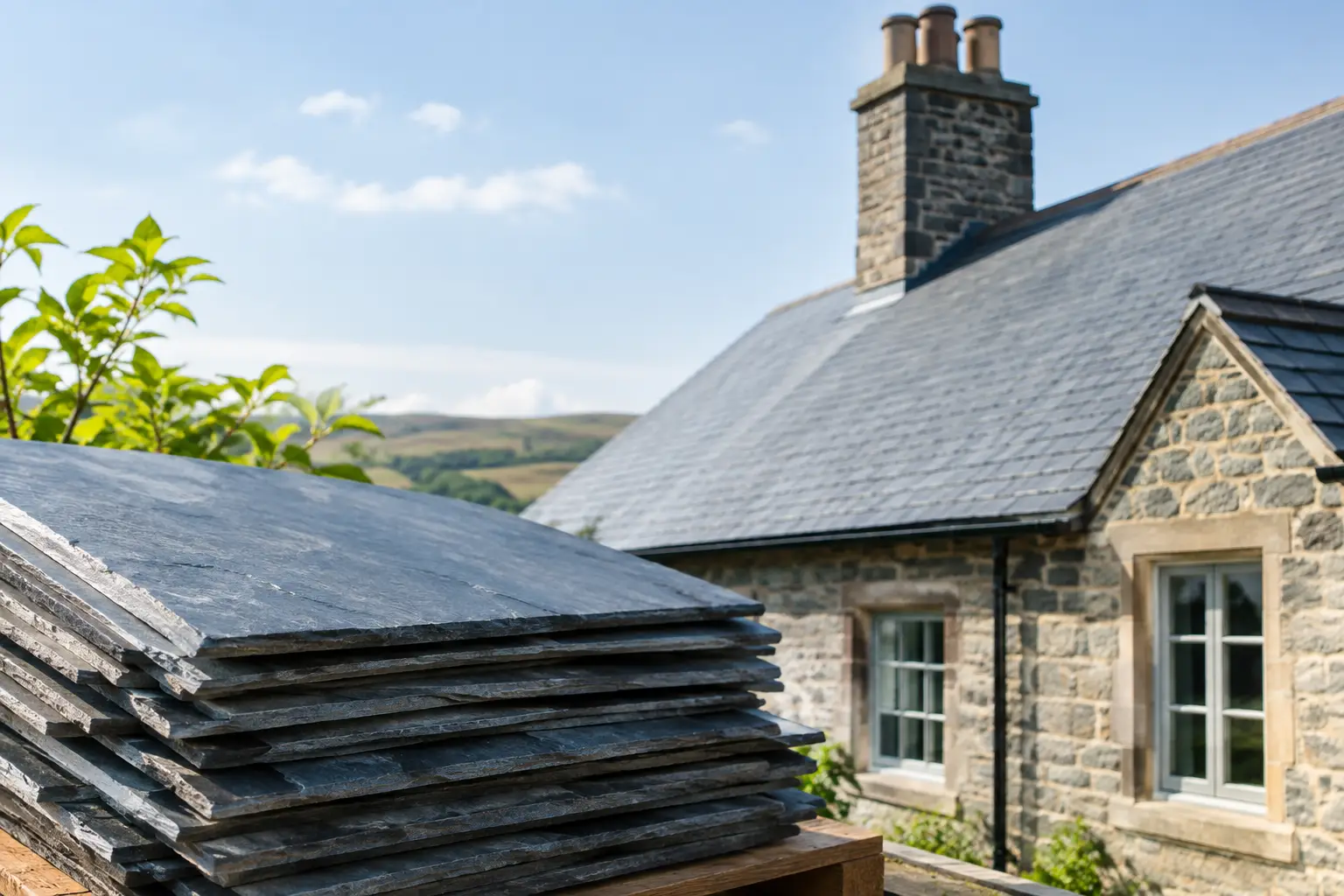
A roof repair rarely needs a newly quarried answer. For period properties in particular, low carbon slate supply starts with a straightforward question: can sound, existing slate be recovered, checked and used again? When the answer is yes, reclaimed slate can preserve the character of the roof while avoiding much of the extraction and processing associated with new material.
That does not mean every reclaimed slate is automatically the lowest-carbon choice, or the right technical choice. Slate must be suitable for its intended exposure, size, fixing method and roof pitch. A credible supply decision balances carbon, condition, compatibility and expected service life. Get those fundamentals right and a reclaimed roof can remain in service for decades.
What low carbon slate supply means in practice
The carbon case for reclaimed roofing slate is primarily about retaining the value already held in the material. A natural slate roof has already absorbed the impacts of quarrying, cutting, dressing and its first installation. Recovering usable slates for a second roof avoids repeating much of that work.
However, supply still has an environmental cost. Slates may need to be stripped, transported, sorted, cleaned, graded and delivered again. The distance travelled, the loading efficiency of the lorry, the rejection rate during sorting and the amount of additional material required all affect the final picture. It is better to describe reclaimed slate as a lower-carbon option with strong circular-economy benefits, rather than make blanket claims without considering the job.
For repair work, the benefit can be especially clear. Replacing a limited area with matching reclaimed slates prevents a roof from being stripped prematurely simply because suitable replacements cannot be found. Keeping the majority of an original roof in place is often the most resource-efficient approach available.
Why authenticity and carbon performance often align
Heritage roofs were built around local materials, traditional headlaps and specific slate sizes. A Welsh slate roof, for example, has a different visual character and weathering pattern from a roof laid in reclaimed Burlington slate or Yorkshire stone slate. Introducing an unsuitable replacement can create obvious patching and may lead to unnecessary wider work later.
Using reclaimed material gives contractors and property owners a better chance of matching colour, thickness, texture and edge detail. This matters on listed buildings, in conservation areas and on ordinary period houses where the roof is a major part of the property’s appearance. It also matters for longevity. A close match is easier to integrate correctly into the existing courses, reducing the temptation to alter the whole roof around a few incompatible pieces.
The lowest-impact specification is not always the closest material geographically. A local reclaimed slate that is thin, heavily delaminated or poorly matched may have a short service life. A sound, accurately graded slate from further away can be the more sensible choice if it avoids repeat repairs and delivers a durable roof. Service life is central to the carbon conversation.
Condition is not optional
Reclaimed slate should be selected as a roofing material, not simply as an architectural salvage item. Sound slates need inspection for excessive thinning, laminations, fractures, nail-hole wear and signs that frost exposure has weakened the stone. The usable proportion of a reclaimed batch is important, particularly on larger projects where consistency of size and thickness affects labour time and laying quality.
Good suppliers sort stock into practical product categories and provide clear dimensions wherever possible. That allows a roofer to plan gauge, headlap and coverage before materials arrive on site. Ordering by tonne can be efficient for substantial works, but the required coverage should always be calculated with allowance for breakage, sorting and the roof’s details.
Choosing the right reclaimed slate for the roof
A low-carbon choice only works when it suits the building. Start with the existing roof rather than a generic product description. Measure several original slates, not just one. Record length, width, thickness, colour variation and whether the roof is laid in diminishing courses. Check the fixing arrangement too, including nail type, batten condition and whether there are copper, lead or other details that must be retained.
For a repair, the practical aim is usually to blend replacements into the existing roof. A varied batch may be ideal where weathering and colour variation are already part of the roof’s character. On a full re-roof, a more consistent supply can make setting out easier while still delivering an authentic reclaimed finish.
There are several points worth settling before placing an order:
- The slate type and dimensions needed to match the existing roof.
- The quantity required, including sensible allowance for cuts, breakages and selection.
- Whether the roof needs standard slates, random widths, diminishing courses or larger stone slates.
- The condition and availability of associated materials such as ridge tiles, valley tiles and leadwork.
- Delivery access, offloading arrangements and dry, secure storage on site.
These details are not paperwork for its own sake. A missed size difference can increase cutting, waste and installation time. A planned order helps ensure that materials arrive once, are handled efficiently and can be installed without avoidable delays.
Carbon savings can be lost through poor planning
Reclaimed slate is often discussed as though the material alone decides the outcome. In reality, project planning has a direct effect on waste and transport. Ordering too little can mean an additional delivery and create colour or thickness differences between batches. Ordering far too much can leave valuable, usable slate without a clear route back into stock.
Accurate roof measurements should include valleys, hips, abutments, dormers and chimney details. These areas generate more cuts and require careful selection. It is also worth considering the supporting roof build-up early. Reusing slate on top of failed battens or inadequate underlay is a false economy, while replacing every component without assessing its condition can add unnecessary material to the project.
Complementary products should be specified for durability and compatibility. Correct slate hooks or nails, suitable battens, breathable membranes, lead flashings and properly formed valleys all support the life of the roof. The aim is not merely to use reclaimed slates, but to create a roof assembly that protects them and reduces the likelihood of early intervention.
The role of salvage and recovery
The supply chain begins before stock reaches a merchant yard. Careful stripping is vital. Slates lifted methodically from a roof are more likely to remain whole and usable than those removed during a rushed demolition. Separation from general waste, sensible stacking and protection from damage all increase recovery yield.
For builders and roofing contractors, identifying salvage potential at survey stage can make a meaningful difference. If a roof is being replaced, its sound slates may have value for another repair or restoration project. That is preferable to sending a durable natural material into mixed waste. It also helps maintain availability of the hard-to-match sizes that older roofs require.
Low carbon slate supply for trade and homeowners
Trade buyers need confidence that stock can support the scope of work, from a few replacements to multi-tonne orders. Homeowners need the same confidence, often with more guidance on what to measure and why slate matching matters. In both cases, a specialist supplier adds value by understanding the difference between a decorative salvage slate and material suitable for a working roof.
ReclaimedRoofSlates.com supplies reclaimed slates alongside the practical components needed to complete roofing work, helping reduce the risk of sourcing mismatched materials from several places. For heritage repairs, that joined-up approach is useful: slates, ridges, valleys, fixings and leadwork should be considered as part of one specification, not as separate afterthoughts.
A quotation request is most useful when it includes photographs of the existing roof, slate measurements, required quantity, location and any known details about the property. Clear information allows the supplier to identify a closer match and advise on likely availability. For urgent storm repairs, even a small sample or a well-lit photograph beside a tape measure can speed up the process.
Build the repair around a material that lasts
The strongest case for reclaimed slate is not that it is old. It is that good natural slate can remain serviceable for a very long time when selected properly and fitted well. Reuse avoids needless demand for new extraction, keeps heritage materials in circulation and helps roofs retain the character they were built with.
Choose on evidence rather than assumption: match the roof, inspect the slate, calculate quantities carefully and specify the supporting materials to the same standard. That is how a low-carbon roofing decision becomes a durable, practical repair rather than a short-term environmental gesture.

