

How to Identify Delaminating Slates on a Roof
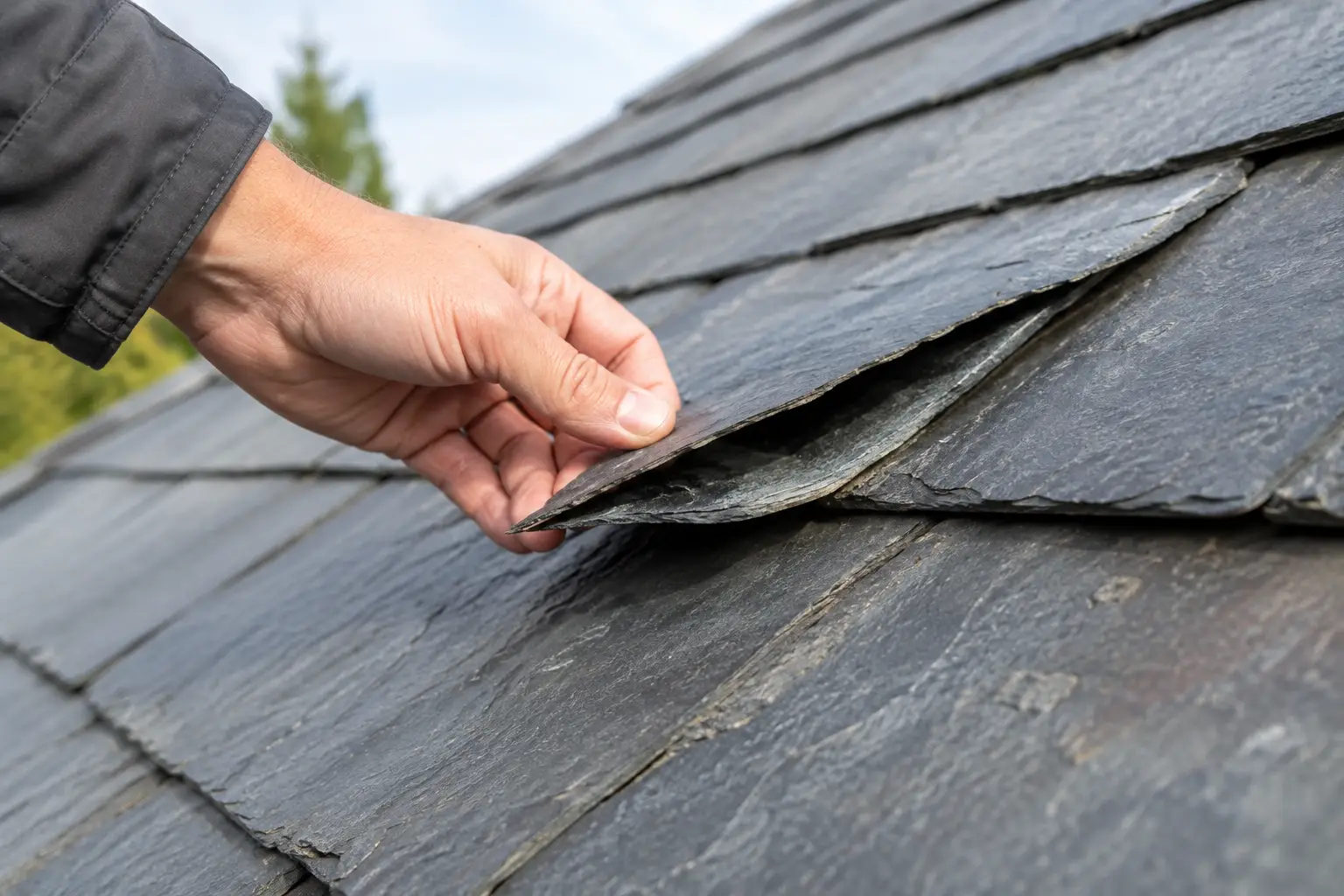
A slate roof can look serviceable from ground level while individual slates are already breaking down in layers. Knowing how to identify delaminating slates helps you deal with isolated defects before they become slipped slates, water ingress and a much larger repair. This matters particularly on period properties, where preserving the roof’s original character often depends on selecting the right replacement slate rather than stripping a sound covering prematurely.
Delamination is not the same as ordinary surface weathering. Natural slate develops a mature appearance over time, and some colour variation, mineral marks and light surface texture are entirely normal. A delaminating slate is structurally deteriorating: thin layers separate from its face or edge, reducing its thickness and eventually its ability to stay weather-tight.
What Delamination Looks Like on a Slate Roof
Slate is formed in natural layers, known as cleavage planes. Good-quality roofing slate splits cleanly along these planes during production but remains stable once laid. Delamination occurs when those layers begin to part after installation. Moisture, frost, impurities within the stone and prolonged exposure can all contribute.
The earliest sign is often a rough, uneven face where the slate once had a clean, flat surface. It may look as if fine sheets have lifted or peeled away. On a roof viewed from the ground, affected areas can appear paler, patchier or more textured than neighbouring slates. Close inspection may reveal shallow depressions, stepped edges or thin flakes collecting in gutters and at the base of valleys.
A delaminating slate can also lose material around the head and nail area. This is more serious than face flaking because the slate may no longer have enough sound material to remain securely fixed. If a slate has become noticeably thinner, brittle at the edges or cracked along its layers, replacement is generally the sensible course.
Signs visible from ground level
Binoculars can help identify patterns without walking on the roof. Look for irregular light patches, slates with ragged lower edges, or groups of units that have a different surface texture to the rest of the slope. Check gutters after heavy rain or frost for slate fragments. A few tiny particles may be harmless historic debris, but repeated flakes or strips of stone suggest active deterioration.
Pay close attention to north-facing slopes, sheltered roof sections and areas below overhanging trees. These can stay damp longer than open elevations. Valleys, abutments and lower courses also deserve scrutiny because water movement and frost action are concentrated there.
Ground-level checks cannot confirm every defect. A roofer inspecting at close range will be able to distinguish surface staining from actual separation within the slate.
How to Identify Delaminating Slates at Close Range
Never walk directly on a slate roof unless you are trained, suitably equipped and using appropriate roof access. Slates can crack under point loading, and an aged roof may not be safe to traverse. A close inspection should be carried out from a properly secured ladder, scaffold, roof ladder or access platform by a competent person.
At close range, examine the exposed face and lower edge of suspect slates. A sound slate should feel dense and look substantially consistent in thickness. It may have natural texture, but its surface should not be lifting in distinct sheets. Delamination tends to create a layered, wafer-like appearance, sometimes described as peeling or spalling.
The following observations usually justify a repair assessment:
- Thin layers are visibly separating from the face, lower edge or sides of the slate.
- The exposed edge has become feathered, soft-looking or markedly uneven compared with adjacent slates.
- The slate has lost thickness in patches, leaving pits, steps or flaky recesses.
- Fragments can be lifted away with very light pressure, without forcing the material.
- Cracks follow the slate’s natural bedding planes rather than running as a single clean break.
Do not test a fitted slate by levering it, scraping it aggressively or striking it with a hammer. Those methods can turn a borderline slate into a broken one. If a slate is already loose or has been carefully removed as part of a repair, an experienced roofer may assess its soundness more fully. For roof-mounted slates, visual evidence and the condition of the fixing area are usually more useful than destructive testing.
Delamination, moss and ordinary weathering are different problems
Moss and lichen can trap moisture and conceal defects, but their presence does not prove that slate is delaminating. Likewise, a weathered slate may show a duller colour or minor mineral inclusions while remaining perfectly sound. Cleaning a roof too aggressively to remove organic growth can damage aged slate and force water beneath the laps, so it is rarely the first answer.
A clean, straight crack is also not automatically delamination. It may result from impact, foot traffic or movement in the roof structure. Delamination is characterised by separation in layers. The distinction matters because a roof with occasional impact damage may need a handful of replacements, whereas widespread layered breakdown can indicate that a particular batch of slates is reaching the end of its working life.
Check Whether the Fault Is Local or Widespread
One defective slate does not mean the whole roof needs replacing. Many older roofs contain a mixture of original, reused and later repair slates, especially where work has been undertaken over several decades. Start by noting how many affected units you can see and where they occur.
If deterioration is confined to a small area around a chimney, valley or leaking gutter, prolonged wetting may be the main cause. Correcting the water-management issue and replacing the damaged slates can be enough. If delamination is scattered across several elevations, including well-drained areas, the underlying slate quality may be the issue.
Inspect the roof fixings at the same time. Rusted nails can allow otherwise sound slates to slip, a problem commonly known as nail sickness. A slipped slate with an intact face is not evidence of delamination. However, nail corrosion and slate breakdown can occur together on an old roof, and both need to be allowed for when pricing a repair.
It is also worth checking whether the underlay, battens and flashings are contributing to persistent damp. Replacing face-damaged slates without dealing with failed leadwork, blocked valleys or poor ventilation may simply expose the new repair to the same conditions.
Deciding When a Slate Should Be Replaced
A slate should normally be replaced when delamination affects its weathering surface, edges or fixing zone. Once the stone is shedding layers, it cannot reliably be restored with sealant or coating. Surface treatments can alter the appearance of a traditional roof, interfere with breathability and hide the true condition of the slate. They do not rebuild lost stone.
For a small number of defects, a competent roofer can remove the affected slates and install matching replacements using an appropriate repair method. The replacement must match more than its visible colour. Thickness, width, length, headlap, hole position, texture and coursing all affect how it performs and how convincing the repair looks.
This is where reclaimed slate is often the practical choice. A well-selected reclaimed Welsh, Burlington or other heritage-compatible slate can blend into an established roof far better than an unsuitable new alternative. It also avoids discarding a roof covering that remains largely sound. ReclaimedRoofSlates.com inspects reclaimed materials and can help buyers source slates by size, type and quantity, whether the requirement is a single repair or a larger restoration order.
Record What You Find Before Ordering Replacements
Before removing any slate, take clear photographs of the roof slope, the damaged area and several sound neighbouring slates. Measure a sample only after it has been safely removed, noting its length, width and thickness. Record the exposed gauge as well, since two slates of the same overall size can be laid differently depending on pitch and headlap.
Where the roof is historic or located in a conservation area, retain samples and seek advice before specifying wholesale changes. Planning or heritage requirements may affect the acceptable slate type, colour and finish. Even when there is no formal restriction, matching the existing material protects the appearance and value of a period property.
A delaminating slate is a warning, not always a verdict on the entire roof. Act on the pattern of defects, the condition around fixings and the cause of any excess moisture. A careful inspection followed by properly matched replacements gives a traditional slate roof the best chance of carrying on for decades.

