

Choosing Replacement Slates for Storm Repairs
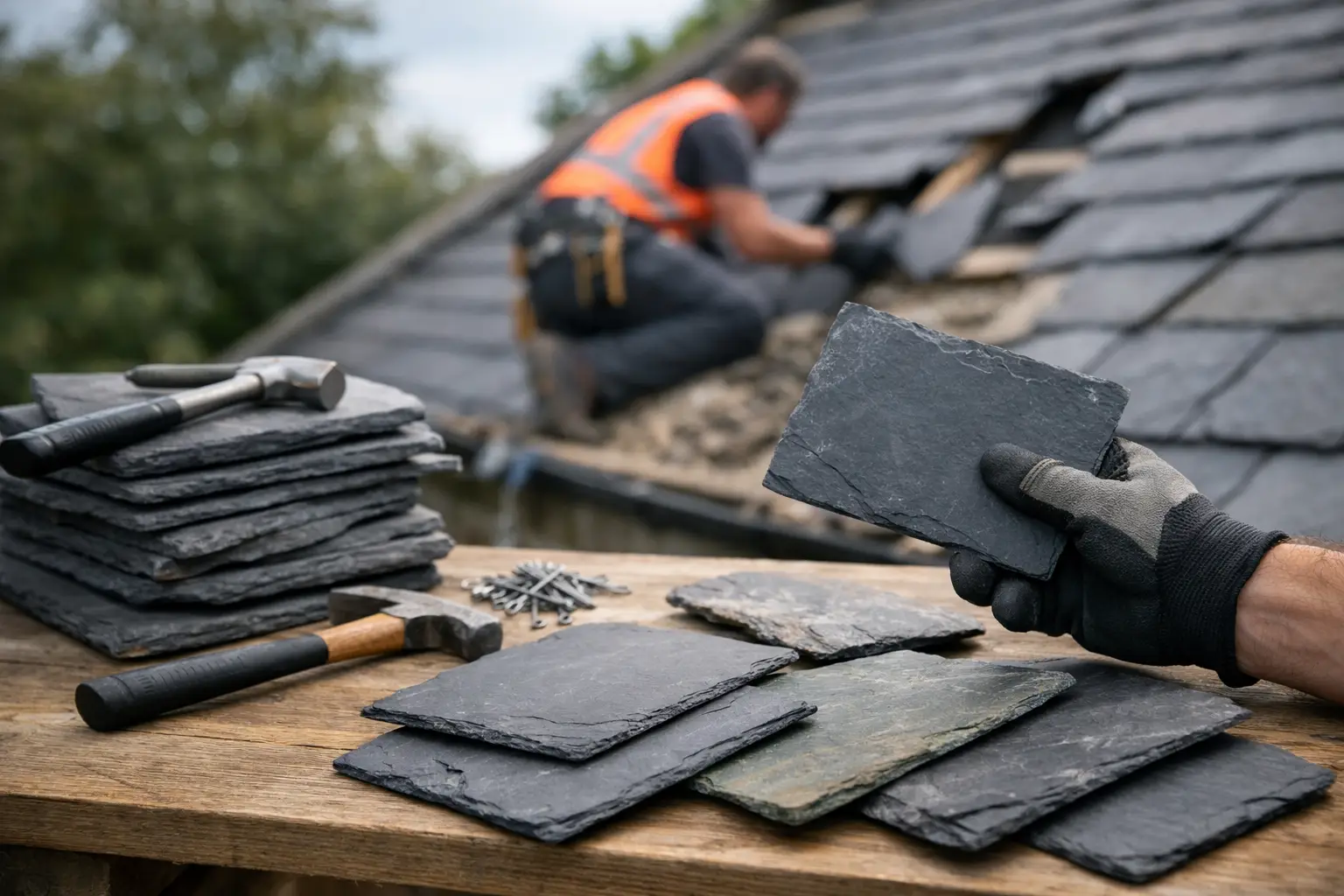
A storm rarely removes slates in a neat, predictable pattern. Wind can lift one loose slate, drive rain beneath surrounding courses and expose weak fixings that were already near the end of their serviceable life. Sourcing the right replacement slates for storm repairs is therefore not simply a matter of filling visible gaps. The repair must restore the roof’s weathering, retain its original character and avoid introducing a slate that looks or performs out of place.
For period properties in particular, a close match matters. A new, uniform slate among weathered natural slates can be conspicuous from ground level. More importantly, the wrong thickness, headlap or fixing detail can disrupt the line of the roof and leave it vulnerable in the next spell of severe weather.
Make the roof safe before matching the slate
After a storm, safety and water exclusion come first. Loose slates, ridge tiles, flashings and broken verge sections should be assessed before anyone works below or attempts a repair. If water is entering the property, a competent roofer may need to install a temporary covering or carry out a short-term make-safe repair while the correct materials are identified.
Do not assume that every missing slate is the full extent of the damage. Check the surrounding courses for cracked corners, lifted tails, nail fatigue and damaged battens. Wind pressure often affects an area rather than a single point, especially at verges, hips, valleys, ridges and around rooflights or chimneys.
A sound inspection also establishes whether the roof can be repaired locally. Several broken slates after a single incident may still call for a straightforward repair. If a large section is slipping, battens have failed or the underlay is extensively compromised, a wider strip-and-repair programme may be more sensible than repeated isolated patching.
What a replacement slate must match
Natural slate roofing is not interchangeable. Two slates of a similar colour may differ significantly in size, thickness, texture, strength and source. Before ordering, take a sound sample from the roof where possible, or provide clear measurements and photographs of the existing covering.
Length, width and thickness
Measure the slate’s length and width accurately, along with its thickness. Slate thickness is especially relevant on older roofs, where a heavier, more substantial covering may have been laid with irregularly graded slates. A thin replacement can sit low against neighbouring slates; an overly thick one can stand proud and interrupt the course.
The slate’s dimensions affect gauge, lap and coverage. A replacement that is too short may not achieve the required headlap. One that is too wide can force tight joints or require unnecessary cutting. For a repair, the aim is normally to preserve the existing setting-out rather than alter it around one available slate.
Colour, grain and surface character
Reclaimed Welsh, Burlington and other natural slates weather in distinct ways. Some roofs carry blue-grey tones, others have green, purple or mixed riven character. Surface texture is just as visible as colour: a smooth, regular slate can look wrong beside heavily riven reclaimed material even if the shade appears close when viewed in isolation.
Natural variation is an advantage, not a fault. Reclaimed stock is often the best route to a convincing repair because it carries the age, texture and tonal movement that new materials may not replicate. That said, reclaimed slates should be quality checked for soundness, delamination and suitable remaining life before they are selected for a roof repair.
Hole position and fixing method
Check the location and condition of nail holes. Historic slates may have been fixed using different hole positions from modern stock, and holes that are enlarged or too close to an edge can weaken the slate. A roofer will also consider whether replacement slates should be nailed, hooked or secured with a repair clip, depending on access, exposure and the construction of the existing roof.
Lead or copper fixings are commonly specified for longevity, particularly on quality natural slate work. The right choice depends on the roof detail and local conditions. Galvanised fixings may have a place in some applications, but they should not be treated as a like-for-like substitute where the existing specification or exposure demands a more durable metal.
Why reclaimed slate is often the practical choice
A storm repair on a Victorian terrace, farmhouse or listed building is rarely improved by inserting a handful of bright, machine-uniform slates. Reclaimed natural slate can provide the visual continuity required for a discreet repair while retaining material already in circulation.
It is also a practical option where original slate sizes are no longer readily produced. Many older roofs use dimensions that do not align with standard modern ranges, or they contain mixed sizes laid in diminishing courses. A specialist reclaimed supplier can help identify suitable stock from dimensions, photographs and a sample, rather than forcing a near match that creates problems on the roof.
There are trade-offs. Reclaimed slate varies by nature, so availability of an exact match may be limited, particularly for uncommon sizes or distinctive regional materials. It is wise to order a sensible allowance where possible, allowing for careful selection, cutting and any future maintenance. The cheapest available slate is not always the economical choice if it does not match in thickness or requires more labour to make it work.
Repair details that are easily missed after storm damage
The missing slate is often the obvious issue, but roof junctions deserve equal attention. A dislodged slate at a valley can indicate damage to valley lining or adjacent tiles. At a chimney, failed soakers, stepped flashing or a cracked mortar fillet can be mistaken for a simple slate problem. At verges and ridges, wind damage may expose insecure bedding, mechanical fixings or failed undercloak details.
When replacement slates are being selected, inspect associated materials at the same time. This may include breathable membrane, timber battens, slate hooks, nails, lead flashing, ridge tiles, valley tiles and suitable sealants. Replacing a slate without addressing a split batten or damaged flashing simply delays the next call-out.
Avoid relying on adhesive as the main means of retaining a slate unless the repair system and roof condition specifically justify it. Sealants can assist with minor detailing, but a slate roof should principally depend on correct overlap, secure fixings and sound supporting components to shed water.
Ordering enough material for a proper repair
For minor work, a roofer may need only a few individual slates. Even then, provide more information than a basic length and width if you can. Include thickness, colour range, photographs of the roof face and close-ups of the broken or removed slate. A sample remains the most reliable way to judge a match.
For larger storm repairs, calculate the area to be stripped and discuss the roof’s existing gauge and lap before ordering by quantity or weight. Tonne-based reclaimed slate orders can be cost-effective for extensive work, but sorting and grading should be allowed for on site. Roofers often separate material by thickness and appearance so the best-matched slates are used in the most visible areas.
If the property is listed or located in a conservation area, check whether there are restrictions on material, colour or detailing before work begins. Planning requirements vary, but heritage officers commonly expect repairs to preserve the existing roof’s material character. A sympathetic reclaimed match can make that process more straightforward than a wholesale change in covering.
Choosing a supplier for replacement slates for storm repairs
A useful supplier will ask the questions that prevent an expensive mismatch: what are the slate dimensions, how thick is the existing roof, is the material Welsh, Burlington or another type, and is the roof laid in regular or diminishing courses? They should also be clear about whether stock is reclaimed, its condition and the likely variation within a batch.
ReclaimedRoofSlates.com supplies inspected reclaimed roofing materials alongside the practical items needed to complete the work, from fixings and lead to battens, valley tiles and ridge components. For a storm repair, being able to source compatible materials from one specialist stockholding can reduce delays while helping the finished section sit naturally within the roof.
A well-executed repair should be difficult to spot and easy to trust. Take the time to match the slate before the work starts, repair the cause as well as the visible damage, and the roof will be better prepared for the weather that follows.

