

Copper Nails vs Galvanised Nails for Roofing
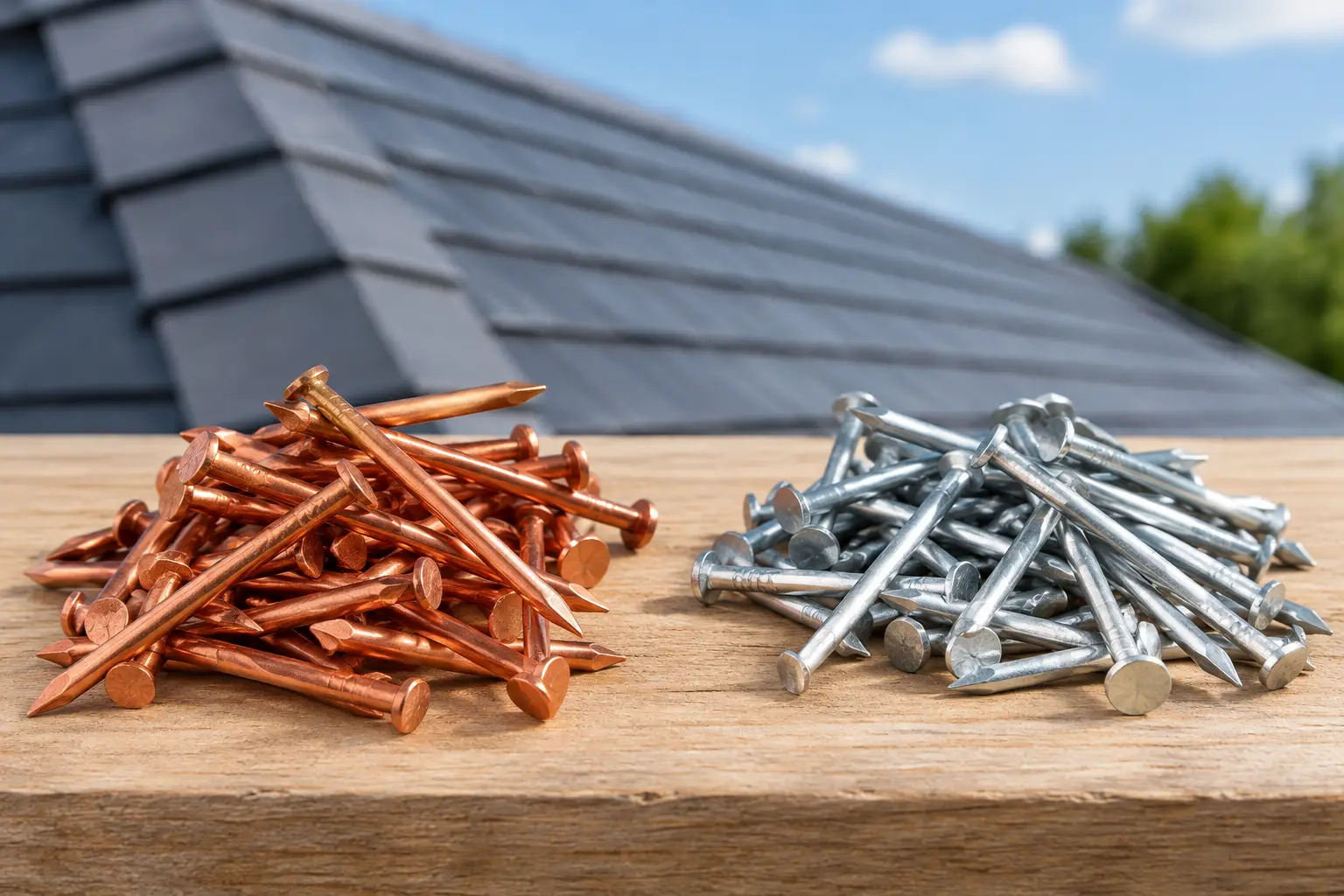
A slate roof can outlast several generations, but only if its fixings are suited to the job. The choice between copper nails vs galvanised nails affects corrosion resistance, heritage appearance, compatibility with surrounding materials and the expected service life of the roof. For a small repair, it can also determine whether replacement slates remain secure while the original roof continues to perform as intended.
Neither fixing is automatically right in every situation. Copper is the traditional long-life choice for many natural slate roofs, while galvanised nails provide a practical, cost-effective option where conditions and specification allow. The correct decision starts with the slate, the roof environment and the materials already in place.
Copper nails vs galvanised nails: the practical difference
Copper nails are made from copper or a high-copper alloy and resist corrosion naturally. Rather than relying on a coating, the metal forms a protective surface patina over time. This makes them particularly well suited to roofs designed for a long service life, including Welsh slate, Burlington slate and many heritage roofing projects.
Galvanised nails are generally steel nails protected with zinc. The zinc coating provides a barrier against moisture and corrosion, but its durability depends heavily on the type and thickness of galvanising. A lightly electro-galvanised nail is not equivalent to a hot-dip galvanised roofing nail. For external roofing work, especially on exposed roofs, the grade of galvanising matters.
The main distinction is simple: copper offers consistently high corrosion resistance throughout the nail, while galvanised steel depends on the integrity of its protective zinc layer. Once that layer is worn, damaged or exhausted, the steel beneath can corrode.
Why nail corrosion matters on a slate roof
A failed slate nail does not always announce itself with an immediate leak. Often, the slate begins to slip as the fixing corrodes or breaks, leaving the head of the nail behind in the batten. This is commonly known as nail sickness. It can affect large areas of an older roof, particularly where poor-quality ferrous fixings were used decades ago.
Natural slate is exceptionally durable, so the nails can become the limiting factor. A reclaimed slate may still be perfectly sound after a century, yet need refixing because the original iron nails have deteriorated. That is why quality fixings deserve the same attention as the slates themselves.
Copper nails are highly resistant to this form of failure. They are a sound choice where the roof is expected to remain in place for many decades and where access for future repairs is difficult or costly. They are also widely specified for conservation work, where a replacement roof should respect traditional construction methods as well as the building’s appearance.
Galvanised nails can deliver good service when correctly specified, particularly on standard domestic roofing work with suitable battens, adequate ventilation and no unusual exposure. However, a roof in a coastal location, an area with persistent driving rain or a heavily shaded site stays wet for longer. In those conditions, the extra durability of copper may justify its higher initial cost.
When copper nails are the better choice
Copper slate nails are particularly appropriate for heritage properties, premium natural slate roofs and repairs where longevity is the priority. They are commonly selected for reclaimed Welsh slates, Burlington slates and other high-quality materials that are likely to outlast ordinary galvanised fixings.
They also make sense when matching an existing roof. If an older slate roof was traditionally fixed with copper, continuing with copper avoids introducing a weaker link into one repaired area. This is especially relevant on listed buildings and period properties, where retaining authentic methods and materials can be as important as achieving a neat finish.
Copper is also compatible with leadwork in a way that suits traditional roofing details. Where lead flashings, soakers or valleys form part of the roof build-up, copper nails are a familiar and dependable choice. The aim is not simply to use traditional materials for their own sake, but to use materials with known long-term behaviour.
The trade-off is cost. Copper nails are more expensive than galvanised alternatives, and the difference becomes noticeable on a full re-roof. Yet the cost of fixings is small compared with the disruption of stripping and repairing a roof because nails have failed prematurely. On a valuable slate roof, this is often a sensible place to avoid false economy.
Where galvanised nails are suitable
Hot-dip galvanised nails are widely used for roofing and can be a sensible option for many projects. They are more economical, readily available and suitable for situations where the roof covering itself has a shorter expected lifespan than a traditional natural slate roof.
They can work well with concrete tiles, certain clay tile applications, temporary works and straightforward repairs where the existing roof uses galvanised fixings. For reclaimed roof tiles or slates on a modest repair, they may offer the right balance of performance and cost, provided the product is genuinely suitable for external roofing use.
The key is to avoid treating all galvanised nails as equal. Nails intended for internal joinery, fencing or general construction may not have the coating quality required for a permanently wet external environment. A roofing contractor should check the manufacturer’s intended use, coating type, nail diameter and head style before fixing.
If the roof is being renewed with long-lasting natural slate, it is worth considering the whole-life cost rather than the price per box. A galvanised nail may cost less today, but copper may better match the service life expected from a first-class slate installation.
Material compatibility and roof environment
Fixings should never be chosen in isolation. The surrounding metals, timber treatment and site conditions all matter. Mixing dissimilar metals can increase the risk of galvanic corrosion when moisture creates an electrical path between them. The risk is greater where water regularly runs from one metal onto another.
For example, copper runoff can affect some adjacent metals and finishes over time. Lead and copper are commonly used together in traditional roofing, but detailing must still be sound. Avoid casual mixing of copper, bare steel, aluminium and zinc components without considering where water will travel. Gutters, valleys, flashings and solar-panel fixings can all influence the choice.
Timber is another consideration. Modern pressure-treated battens may contain preservative chemicals that are harder on some metals than untreated timber. Use fixings suitable for treated timber and follow the batten and fixing manufacturer’s guidance. The nail needs to perform not only against rainwater above the slate, but also within the batten below it.
Exposure matters just as much. A sheltered roof in an inland town faces a different corrosion challenge from a roof on an elevated Yorkshire hillside or close to the coast. Salt-laden air, pollution, wet vegetation and poor ventilation all increase the demand placed on fixings.
Nail type, size and fixing technique
Whether choosing copper or galvanised nails, use slate nails rather than ordinary round-wire nails. A broad, flat head helps retain the slate without concentrating pressure at the nail hole. The shaft diameter must suit the pre-punched or drilled hole, while the nail length must provide secure penetration into the batten without creating unnecessary splitting risk.
As a practical rule, the nail must pass through the slate and achieve adequate purchase in the batten. The exact length depends on slate thickness, batten depth, roof pitch and the fixing specification. It should be checked against the requirements for the particular slate and roof system rather than guessed on site.
Do not drive slate nails tight. A slate needs to hang from its nails, with the head resting lightly against the surface. Overdriving can crack the slate or prevent normal movement, while an under-driven nail can catch the slate above. This small detail has a major effect on a roof’s finish and durability.
For repairs, inspect the existing nail holes carefully. Reclaimed slates may have holes from a previous fixing pattern, and forcing a nail into an unsuitable hole can split the slate. In some cases, a different hole position or a correctly sized repair slate is the better solution.
Making the right buying decision
For a long-life natural slate roof, particularly on a heritage or period property, copper nails are usually the strongest choice. Their corrosion resistance, traditional credentials and compatibility with high-value slate work make the higher purchase price easier to justify.
For less demanding work, or where specification and exposure support their use, quality hot-dip galvanised slate nails remain a capable and economical fixing. The important point is to choose roofing-grade galvanised nails, not simply the cheapest galvanised nail available.
When sourcing reclaimed slates, it is worth planning the fixings at the same time as the slate quantity, battens, leadwork and ventilation details. A roof performs as a system, and the smallest component can decide how long that system remains secure. Choosing the right nail now protects the character, value and weatherproofing of the roof for years to come.

