

Best Roof Valley Linings for Heritage Roofs
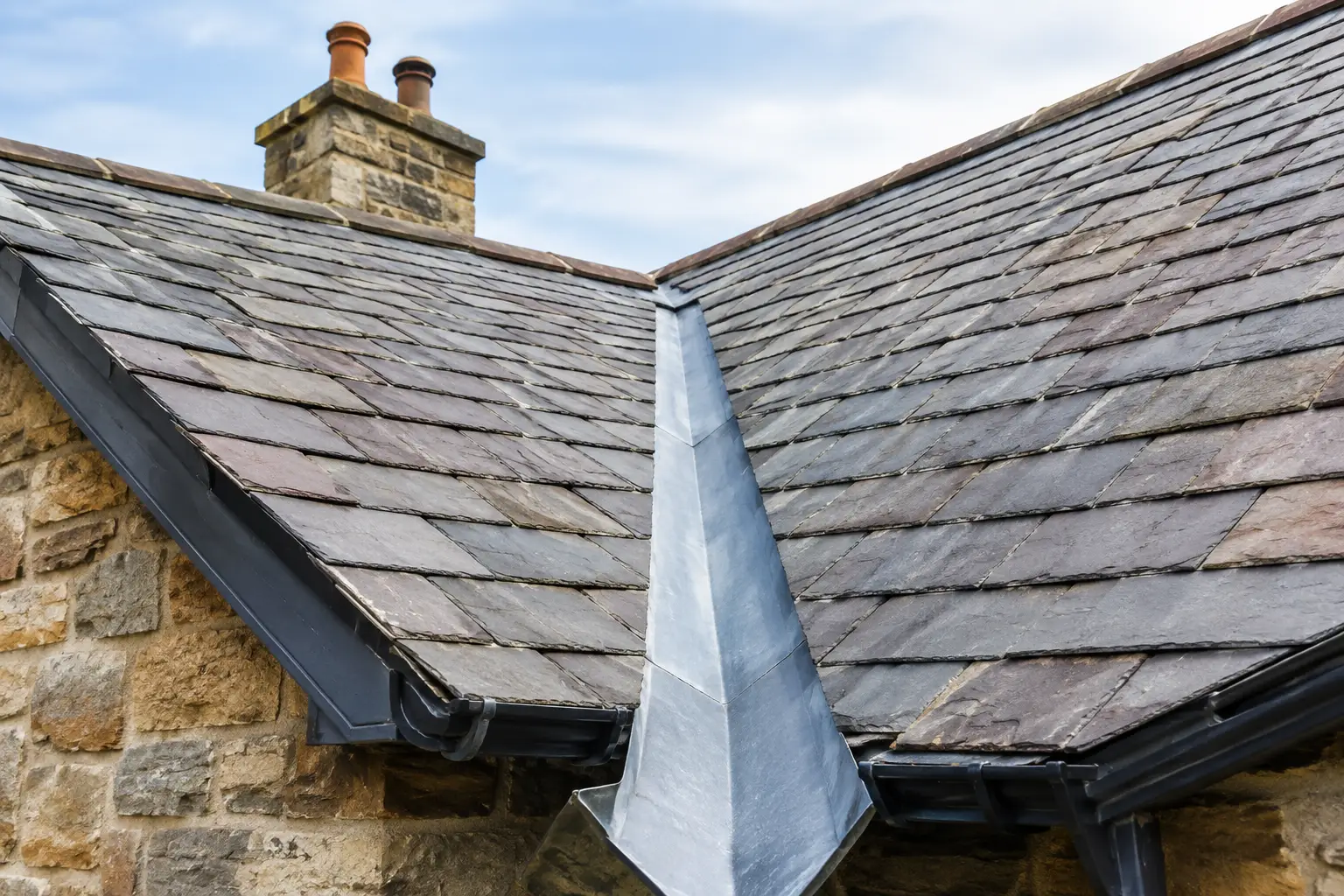
A roof valley carries more water than almost any other part of a pitched roof. When its lining fails, water can track beneath slates or tiles, saturate battens and felt, and cause damage well beyond the visible leak. The best roof valley linings are therefore not simply the most expensive option. They are the lining that suits the roof covering, pitch, valley length, exposure and character of the property.
For period homes and traditional slate roofs, getting this detail right also protects the appearance of the roof. A bright modern channel or an oversized dry-valley profile can look out of place beside weathered Welsh slate, Burlington slate or handmade clay tiles. Performance comes first, but compatibility matters.
What a roof valley lining needs to do
A valley is the internal junction where two roof slopes meet. Rainwater from both slopes is directed into that channel, so the lining must cope with concentrated flow, wind-driven rain and debris. It must also allow for movement caused by seasonal temperature changes without splitting or pulling away from adjacent coverings.
The right specification depends on more than the roof material. A shallow valley, a long rafter run, a roof beneath trees, or an exposed elevation can all demand a wider or more substantial valley detail. Local planning conditions and conservation requirements may also affect what is acceptable on a listed building or within a conservation area.
In practice, the best result comes from treating the valley as part of the whole roof build-up. The lining, underlay, battens, fixings, slate or tile size, headlap and drainage route all need to work together.
Best roof valley linings by roof type
Lead-lined valleys
Lead remains the established choice for many traditional roofs, particularly natural slate, stone slate and heritage clay tile work. It is long-lasting, adaptable, and capable of forming clean, understated valleys that sit comfortably within an older roof. Correctly detailed lead has a proven record on historic buildings throughout the UK.
Its main advantage is flexibility. A competent roofer can form the lining to suit the valley angle and dress it properly beneath the slates or tiles. Lead also copes well with complex junctions where a proprietary trough may not fit neatly.
The trade-off is that leadwork must be correctly sized and detailed. Lead that is too thin, laid in excessively long lengths without suitable expansion provision, or restrained with unsuitable fixings is prone to fatigue and cracking. Code selection should be based on the valley design and recognised leadwork guidance, not guesswork. On a valuable slate roof, it is rarely sensible to economise on this point.
Lead valleys suit projects where visual continuity, repairability and long service life are priorities. Reclaimed slates paired with properly installed lead are often the most convincing solution for a period-property reroof or localised repair.
GRP valley troughs
Glass-reinforced plastic, usually shortened to GRP, offers a lightweight and practical alternative for many tiled and slated roofs. Preformed GRP troughs provide a consistent channel and are generally quicker to install than site-formed lead. They do not require the same allowance for thermal movement as lead, and their uniform shape can help when programme time is tight.
A GRP valley is particularly useful on straightforward domestic roof pitches with standard-sized tiles or slates. It can be a sensible choice for modern extensions, garages, outbuildings and repairs where the existing roof already uses a similar system.
However, not every GRP trough is appropriate for a heritage roof. The visible edges and moulded profile can be more noticeable than lead, especially beside uneven reclaimed slate or thick Yorkshire stone slates. Check the trough width, colour and edge detail before specifying it. A narrow channel may be insufficient where water volumes are high, while a bulky profile can disrupt the lines of a refined traditional roof.
Preformed dry valley systems
Dry valley systems use a purpose-made trough, usually in plastic or GRP, with a mechanical fixing method rather than mortar. They can offer a tidy, low-maintenance detail for concrete or clay tiles, and they avoid mortar cracking at the valley edge.
For standard tile work, this is often a dependable option where the product is matched to the roof pitch and tile profile. It is also useful where a contractor needs a repeatable installation detail across several similar roofs.
Their limitation is appearance and flexibility. Dry valleys are usually best suited to modern roofing materials with regular courses. They can be difficult to integrate convincingly with handmade tiles, irregular reclaimed tiles or diminishing-course slate roofs. On a period house, the quickest fitting system is not always the right visual or technical choice.
Tile valley systems
Valley tiles, including traditional clay valley tiles, create a visible channel between two tiled slopes. They can be highly appropriate on certain heritage roofs, particularly where they match the original construction and surrounding clay tilework. Their character is difficult to replicate with a flat lead valley or modern plastic trough.
These systems demand accurate setting out. The tile gauge, roof pitch, side laps and support beneath the valley all matter. Replacement valley tiles should match the existing profile, size, colour variation and weathered finish as closely as possible. A mismatched new valley can stand out more than a handful of replacement field tiles.
Tile valleys are not automatically the best option for every roof. They may be less suitable where the valley geometry is irregular, water flow is heavy, or the original design has already proved troublesome. Existing evidence on the roof should guide the decision.
How to choose the right material
Start with the roof itself rather than a preferred product. A slate roof generally calls for a different approach from a machine-made concrete tile roof, while a hand-made Rosemary tile roof may need a solution that respects its established valley detail.
Four checks should shape the specification:
- Roof covering and character: Natural slate, stone slate, clay tile and concrete tile each have different thicknesses, coursing and visual requirements.
- Pitch and water volume: Long valleys and lower pitches need particular attention to channel width and the risk of water backing up beneath the covering.
- Exposure and debris: Open sites face wind-driven rain, while valleys beneath trees need a detail that can be kept clear and will not trap leaves.
- Condition of the surrounding roof: Failed battens, degraded underlay, slipped slates or broken tile nibs should be addressed at the same time as the valley lining.
For a small repair, inspect why the original valley failed before choosing a replacement. A split lead lining may be the result of poor fixing or inadequate expansion allowance, rather than evidence that lead itself is unsuitable. Likewise, repeated mortar failure at a tile valley may point towards a dry system, provided it does not compromise the building’s appearance.
Detail matters as much as the lining
Even the best material will fail if the surrounding work is poor. The valley must be supported properly, kept free of sharp edges, and formed to discharge water cleanly into the gutter. Underlay should be dressed and supported so that any secondary water is directed into the valley rather than behind it.
Slates and tiles alongside the channel need consistent cutting and adequate lap. Tight, irregular cuts create pinch points where debris gathers; overly wide gaps can look poor and leave the lining unnecessarily exposed. On reclaimed roofs, take time to select slates or tiles of compatible thickness around the valley. This helps maintain an even surface and avoids rocking units or weak fixings.
Fixings also deserve attention. Copper, stainless steel or other suitable corrosion-resistant fixings are commonly used where they are compatible with the roofing system. Avoid shortcuts that puncture or restrain a lining where it needs freedom to move.
Matching valleys on heritage and reclaimed roofs
A valley repair is often carried out after storm damage or a localised leak, when the rest of the roof is sound and heavily weathered. In that situation, a technically correct repair can still look wrong if replacement materials are too new, too regular or the wrong geological type.
This is where reclaimed materials have practical value. Matching reclaimed Welsh slate, Burlington slate, Yorkshire stone slate or heritage clay tiles can preserve the roof’s established texture and colour variation. The valley should then be selected to complement that covering, not force the covering to suit a convenient off-the-shelf system.
For larger work, set aside enough matching material for the valley margins before laying the main roof. Roofers should not be left trying to make a valley work with the last mixed batch of slates or tiles on site. A specialist supplier such as ReclaimedRoofSlates.com can help identify compatible reclaimed roofing materials and supporting products before installation begins.
A final practical point
Do not wait for staining on ceilings to treat a valley as a priority. Check it after severe weather and whenever gutter cleaning is carried out, looking for displaced slates, cracked edges, trapped moss and signs of water tracking. A well-chosen valley lining, fitted with care and kept clear, gives the rest of the roof the chance to perform as it should.

