

Reclaimed Slate Versus New Slate for Your Roof
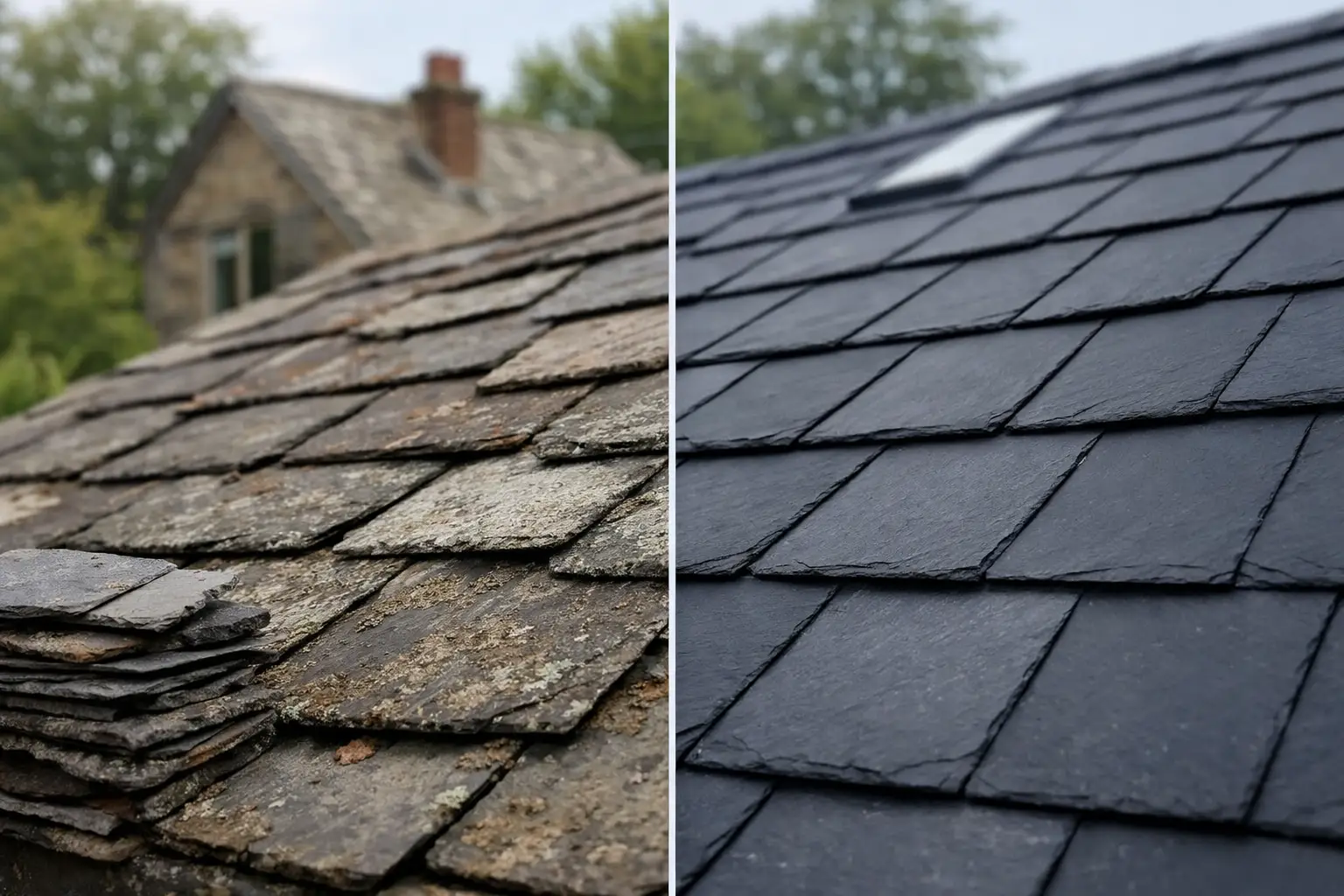
A single slipped or broken slate can make the choice clear: a bright, uniform replacement on a weathered roof often looks wrong before the scaffolding has come down. Reclaimed slate versus new slate is not simply a question of old against modern. It is a decision about matching, performance, availability, budget and the character of the property beneath the roof.
For a period house, listed building or established roof with decades of weathering, the right material can preserve visual continuity and avoid unnecessary disturbance. For a complete reroof, new slate may offer a more predictable specification and supply. The detail of the job matters.
Reclaimed slate versus new slate: the core difference
Reclaimed slate has been carefully removed from an existing roof, sorted and assessed for further use. It carries the natural variation developed through quarrying, hand dressing, fixing holes and years of exposure. Welsh, Burlington and other established roofing slates can retain a long useful life when they have been properly selected and graded.
New slate is freshly quarried or manufactured and supplied to a defined size, thickness and finish. Natural new slate remains a high-performing roofing material, while manufactured alternatives can provide a more consistent appearance and a lower initial outlay. These are different products with different strengths, rather than direct like-for-like substitutes.
The key question is whether the roof needs to blend in, meet a particular heritage requirement, or start afresh with a controlled, repeatable specification.
When reclaimed slate is the right choice
Reclaimed slate is usually the strongest option for repairs and partial renewals to traditional roofs. A good match takes account of more than colour. Slate size, thickness, edge character, surface texture, coursing and degree of weathering all affect whether a repair disappears into the existing covering or stands out from street level.
This matters especially on Welsh slate roofs, where older slates may have distinctive blue-grey, purple or green tones, and on roofs laid with mixed or diminishing courses. Reclaimed material gives a roofer the opportunity to select slates that sit naturally among the originals. It is also often the practical answer where an older size is no longer routinely available as a new product.
There is a sustainability benefit as well. Reusing sound slate keeps a durable material in service and reduces demand for newly extracted material. For owners restoring period properties, that is not a marketing point alone. It supports an authentic repair using materials appropriate to the building.
Reclaimed stock can also be valuable when planning or conservation expectations call for retention of the roof’s established appearance. Requirements vary by local authority and by property, so it is sensible to check what is required before ordering material or stripping a roof.
Condition and grading are not optional
Age does not make a slate inferior, but neither does age guarantee quality. Reclaimed slates should be inspected and sorted to remove pieces that are fractured, delaminating, excessively thin or otherwise unsuitable for reuse. Sound slates need sufficient strength around nail holes and edges, particularly where they will be handled, holed or redressed during fixing.
A reputable reclaimed supplier should be able to discuss the slate type, approximate dimensions, thickness range and quantity available. For larger jobs, consistency across the order matters. A roof can accommodate character, but it cannot accommodate random variations that disrupt gauge, lap or fixing.
Where new slate has the advantage
New slate is often the more straightforward route for a full reroof where there is no existing covering to match. It allows the contractor to work from a known specification, with consistent dimensions and a planned quantity from the outset. That can simplify setting out, estimating coverage and maintaining a regular appearance across large roof areas.
It is also a sensible choice where the project demands a specific guarantee, a particular declared performance standard or a uniform finish. New natural slate can provide exceptional longevity, provided the slate type, pitch, fixing method and detailing are suitable for the roof.
Availability can be another deciding factor. Reclaimed materials are finite and stock changes as roofs are stripped and salvaged. A large matching quantity may be available, but it should be secured early, particularly if the project requires an uncommon size or a particular regional slate. New slate is generally easier to specify repeatedly for phased work or substantial developments.
That said, a uniform new roof is not always the desired result. On an older property, particularly where only one slope is being renewed, a clean and consistent finish can look noticeably separate from the retained sections.
Appearance, matching and roof character
The visual case for reclaimed slate is strongest when repairing an existing roof. New slate, even from the same broad geological family, may differ in sheen, texture and tone from material that has weathered for fifty or a hundred years. It will weather over time, but it will not provide an immediate match.
A sample is useful, but it should not be the only basis for selection. View the roof from ground level, assess the dominant slate sizes and note whether the covering is regular or deliberately varied. On many traditional roofs, slate thickness changes subtly through the courses. Replacing all of that variation with a thin, uniform product can alter the roof’s character.
For a complete reroof, the decision becomes more personal and practical. Reclaimed slate can create an established, traditional finish from day one. New slate provides a crisp, controlled look. Neither is automatically better, but the roof should look appropriate to the building and its surroundings.
Cost is more than the price per slate
Comparing prices by the individual slate rarely gives a reliable project cost. Reclaimed slate may involve more sorting, selection and allowance for variation. New slate may cost less to lay in some cases because dimensions are consistent, although the material itself can vary significantly by source and quality.
The wider cost should include delivery, wastage allowance, sorting, labour, fixings, underlay, battens, leadwork and roof access. A repair also carries the cost of getting the match wrong. Replacing a handful of slates with unsuitable material can leave a visible patch that needs correcting later.
For reclaimed orders sold by weight or tonne, confirm the likely coverage for the slate size and lap required. Coverage is affected by headlap, side lap, roof pitch and the condition of the slates. A tonne is not automatically a fixed roof area.
A contractor should also establish whether spare slates are needed for future maintenance. Keeping a modest quantity of matching reclaimed slate on site or in storage can save considerable time when later storm damage occurs.
Installation details still decide the lifespan
The quality of slate is only part of the roof’s performance. Incorrect gauge, inadequate lap, unsuitable nails, poor ventilation or weak lead detailing can shorten the life of either reclaimed or new slate. The roof covering must be designed around its pitch, exposure and drainage requirements.
Reclaimed slates may need careful sorting by thickness before laying so courses sit properly and the roof remains true. Nail holes require particular attention. Existing holes can sometimes be used where their position is suitable, but a competent roofer will determine whether redressing or alternative fixing is needed. Never assume an old hole is sound simply because the slate itself appears intact.
New slate also needs the correct fixing approach. Slate nails, hooks, battens and underlay should be selected as a system for the roof rather than treated as secondary items. Valleys, abutments, ridges and verges deserve the same care as the main slope, particularly on exposed elevations.
How to make the right purchasing decision
Start with the existing roof. If the work is a repair, measure several slates rather than one, record their exposed length and width, and photograph the roof in natural light. Note the thickness, colour variation and any distinctive dressed edges. This information gives a specialist supplier a proper basis for identifying suitable reclaimed material.
For a full reroof, decide whether the priority is heritage character, a uniform specification, immediate availability or a defined budget. There may be a sensible middle ground: reclaimed slate for prominent elevations or repairs, with compatible new material where appropriate and approved.
Before placing an order, confirm the quantity, size range, condition standard and delivery arrangements. Ask whether the stock is from one source or a mixed batch, especially where a close match is required. For heritage work, retain samples and agree the intended appearance before the bulk material is laid.
ReclaimedRoofSlates.com supplies reclaimed roofing materials alongside the battens, fixings, lead and day-to-day accessories needed to complete the job, helping contractors avoid treating the roof covering as an isolated purchase.
The most reliable choice is the one that respects the existing roof, suits the scope of work and can be installed correctly. A sound reclaimed slate can be the natural continuation of a historic roof; a well-specified new slate can be the right foundation for the next century of service. Start with the roof in front of you, not a generic product comparison.

