

Guide to Rosemary Roof Tiles for Period Roofs
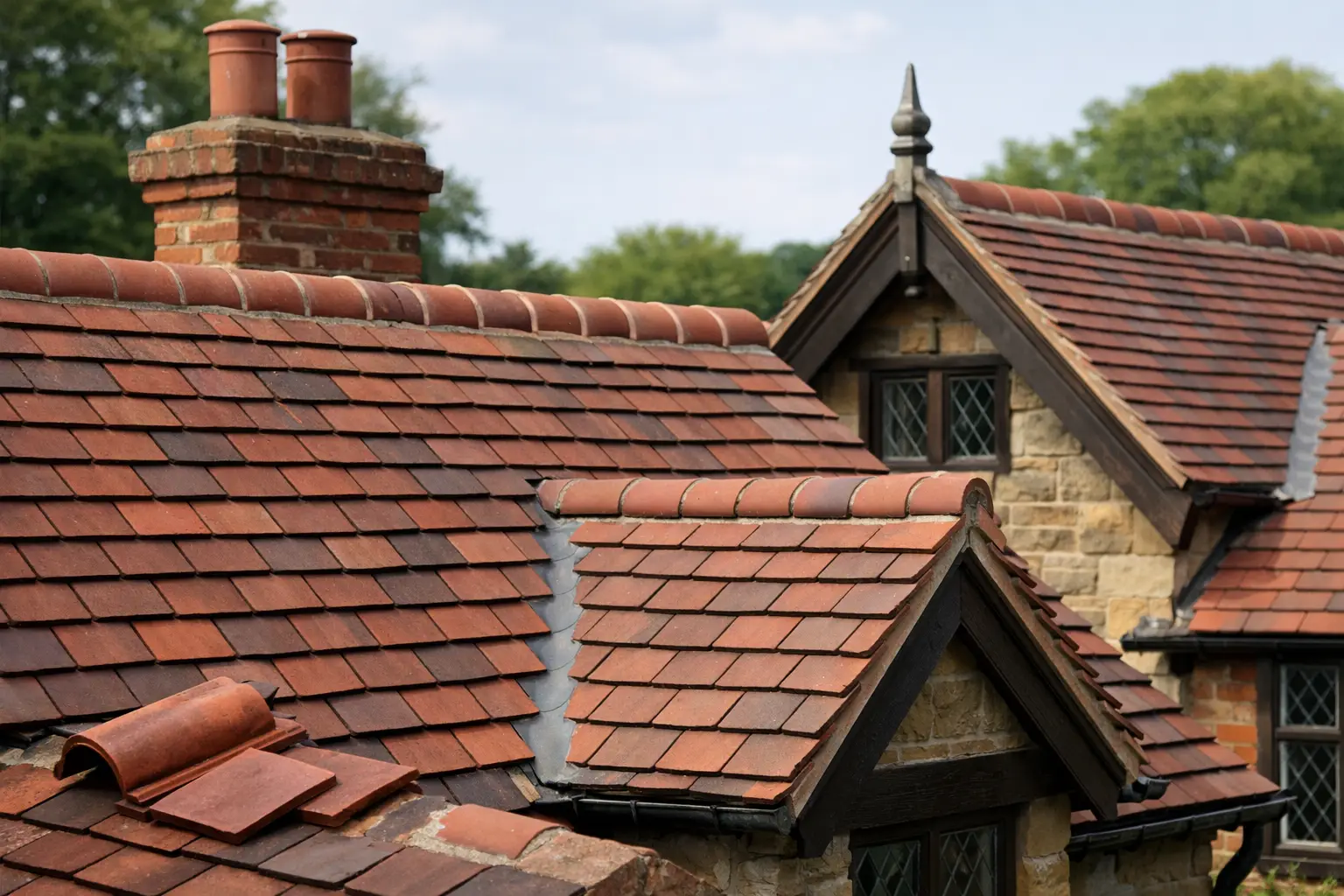
A missing or broken tile can look like a small repair until the roof is viewed from the ground. On a period property, a poor match in colour, profile or weathering can stand out immediately. This guide to rosemary roof tiles explains how to identify the right material, specify reclaimed stock correctly and avoid the common mistakes that compromise an otherwise sound repair.
What are Rosemary roof tiles?
Rosemary tiles are traditional clay plain tiles, widely used across Britain on Victorian, Edwardian and early twentieth-century properties. Their familiar double-camber profile creates a more textured roof finish than a flat plain tile, with a strong shadow line that suits both town terraces and larger country houses.
The name is often used as a general description, but it can also relate to particular manufacturers and production periods. That matters when matching an existing roof. Tiles described as Rosemary can differ in size, thickness, nib position, camber, clay body and finish. A tile that appears close in a photograph may not sit correctly alongside the original covering.
Reclaimed Rosemary tiles remain a practical choice because they bring genuine age, weathering and colour variation to a repair. Where an old roof has mellowed over decades, new tiles can look noticeably sharper and more uniform. Reclaimed stock is usually the better route where visual continuity and heritage character are priorities.
Identifying the tile before ordering
Do not order on the name alone. Remove a sample tile from a safe, representative part of the roof and inspect it on both sides. Record its overall length and width, thickness, the position and form of the hanging nib, and the shape of its lower edge. Measure several tiles rather than relying on one, as older roofs often contain small variations from different batches or previous repairs.
The profile is particularly significant. Rosemary tiles have a recognisable shaped face, but the depth and form of that shape can vary. Put a prospective replacement against the original, ideally face to face and back to back. This quickly exposes differences that are difficult to see in a product image.
Colour needs the same careful approach. Terms such as red, brindle, brown and antique describe a broad range rather than a fixed shade. A roof may include fired reds, smoky browns and darker weathered tiles all at once. A sensible reclaimed selection should work with that natural variation, not create an isolated patch of one colour.
For larger projects, send clear photographs of the roof, close-ups of the tile face and underside, plus measurements. This gives a specialist supplier the information needed to identify compatible stock and advise whether a blend is likely to give the best result.
Reclaimed or new Rosemary tiles?
New clay tiles offer consistency, predictable availability and a clean finish. They can be suitable on a complete re-roof where the intended appearance is uniform, or where planning requirements allow a new covering. However, they may be unsuitable for a local repair to an aged roof, especially where only a small number of tiles are being replaced.
Reclaimed Rosemary tiles have already completed years of exposure. Their colour is settled, their surface is naturally weathered and their character is difficult to reproduce from a new product. They are particularly useful for repairs to listed buildings, conservation-area properties and homes where the existing roof has a distinctive aged appearance.
There is a trade-off. Reclaimed materials require proper sorting and inspection, and available quantities can vary. A supplier should be able to confirm the approximate dimensions, condition and quantity of the batch before supply. For a substantial roof, reserve sufficient stock at the outset. Trying to source the same reclaimed batch later can be difficult.
A guide to Rosemary roof tiles and roof pitch
Plain clay tiles rely on overlap to shed water, so the roof pitch, batten gauge and headlap must be considered together. Do not assume an existing gauge is automatically correct simply because the roof has been in place for many years. Previous repairs may have altered the setting-out, or the roof may have been laid to an older specification.
The correct batten gauge depends on the tile length, the pitch, exposure and required headlap. A lower-pitched or more exposed roof generally needs greater overlap, which reduces the effective cover of each tile and increases the number required. The manufacturer’s guidance, current roofing standards and the project specification should determine the final layout.
This is also why tile count should never be based only on the roof area. Calculate coverage using the actual tile dimensions and proposed gauge, then add an appropriate allowance for cuts, breakages, sorting and future repairs. Hips, valleys, dormers, rooflights and abutments all increase waste and labour.
Before stripping a roof, check that the rafters, battens and supporting structure are suitable for the intended covering. Clay plain tiles are not a lightweight finish, and a period roof may need repairs to timbers or upgrades to battens before re-covering begins.
Sorting reclaimed stock properly
A reclaimed tile is not automatically a usable tile. Quality depends on how it has been recovered, handled, stored and inspected. Every tile should be checked for cracks, severe delamination, frost damage and excessive distortion. Light surface wear is expected and often desirable, but structural defects are not.
A practical sorting process separates sound full tiles from damaged pieces, cuts and tiles suitable only for less visible locations. Ringing a dry clay tile gently can help identify obvious fractures, although it is not a substitute for visual inspection. Pay close attention to the hanging nib. A damaged nib can prevent the tile from hanging securely and may lead to uneven courses.
For a repair, use the best visual matches in the most prominent area. Slightly more varied tiles can be worked into less visible slopes, provided they remain technically compatible. On a complete re-roof, blend tiles from across the batch during laying rather than emptying one pallet at a time. This prevents colour blocks and produces a more natural roofscape.
Details that make or spoil the finished roof
Field tiles are only part of the job. Ridge tiles, hip tiles, valley tiles, eaves details and verges need to be considered before work starts. An otherwise well-matched Rosemary roof can look wrong if the ridge profile is too modern, the valley detail is poorly formed or the verge treatment does not suit the property.
Valleys deserve particular care. They carry concentrated water flow and require the correct valley construction, lining and tile cuts. Leadwork around chimneys, abutments and dormers should be formed to accepted practice and detailed to allow for movement. Reusing old lead simply because it is present can be a false economy if it is thin, split or fatigued.
Use suitable fixings for the location and exposure. Nail type, length and fixing frequency depend on the tile, batten, pitch and wind loading. Mechanical fixing may be required in exposed areas or at roof edges, even where much of the main slope is traditionally laid. Follow the relevant fixing specification rather than relying on habit.
Ventilation and underlay also need a balanced approach. A period roof should not be made airtight by accident, but neither should its weather resistance be compromised. The right approach depends on whether the roof space is cold, insulated at rafter level or part of a wider refurbishment.
Planning, conservation and practical ordering
Where a property is listed or lies in a conservation area, check whether consent is needed before changing the roof covering. Planning conditions may specify the material, colour, profile or method of laying. Retaining sound original tiles wherever possible is often the best outcome, with reclaimed Rosemary tiles used to replace only the failed or missing units.
Order with the full scope in mind. Alongside the main tiles, confirm requirements for ridge and valley components, breathable membrane or underlay, battens, fixings, lead, sealants and safety equipment. Having compatible materials on site avoids delays once the roof is open to the weather.
A reliable match starts with a real sample, accurate measurements and an honest assessment of the roof rather than a guess from its street appearance. For a small repair or a full heritage re-roof, the right reclaimed Rosemary tiles should disappear into the existing roof – leaving the property looking properly maintained, not recently patched.

