

Why Do Roof Slates Slip? Causes and Repairs
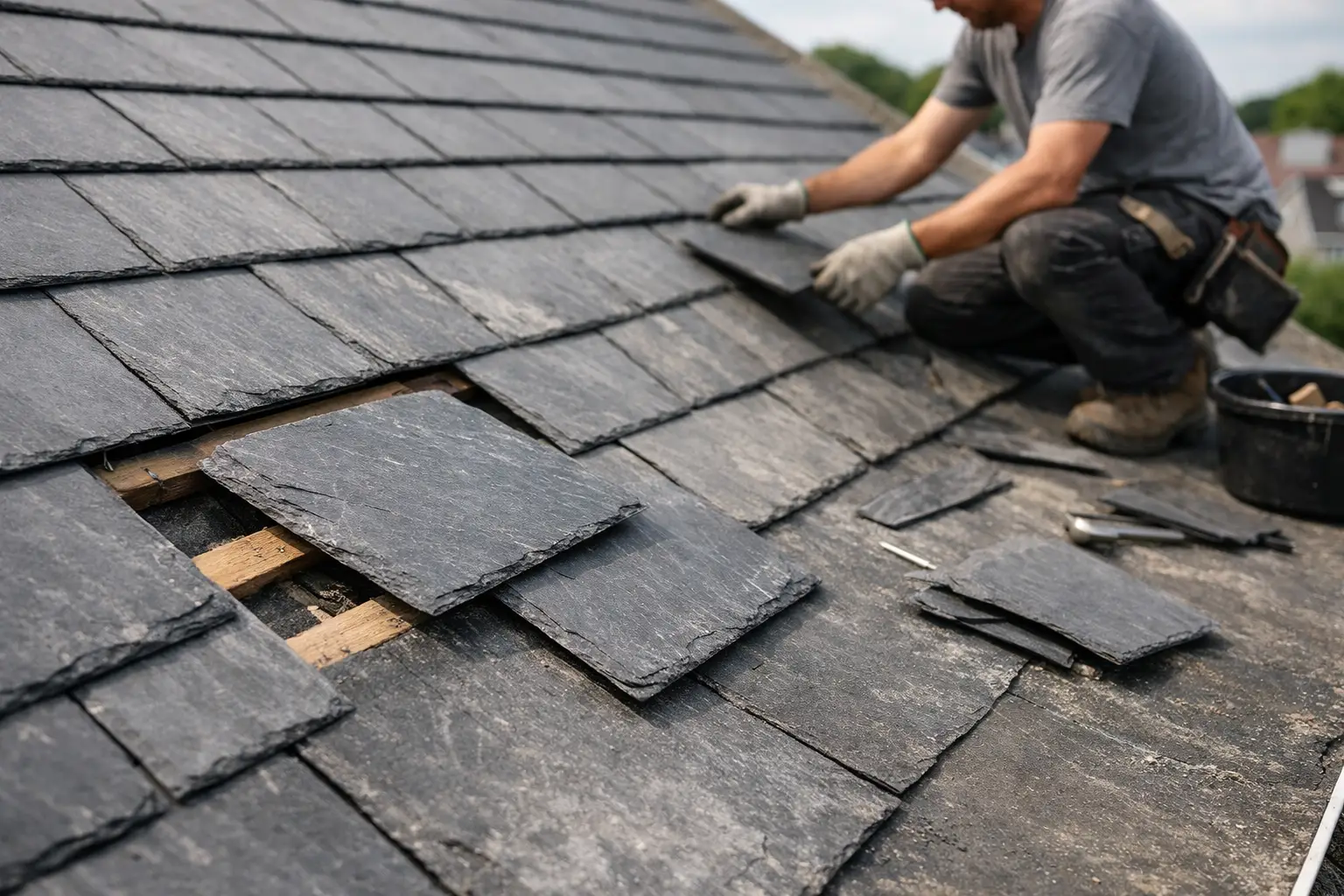
A slate lying in a gutter is rarely an isolated problem. When asking why do roof slates slip, the answer is usually that a fixing, batten or section of the roof covering has reached the end of its serviceable life. On a period property, that one slipped slate may be the first visible warning of wider deterioration hidden beneath an otherwise sound-looking roof.
Natural slate can last for generations. Its performance depends on the details that hold it in place: correctly specified nails or hooks, sound battens, suitable laps and a roof structure capable of keeping everything aligned. A lasting repair starts by identifying the failure properly, rather than simply pushing a replacement slate into the gap.
Why do roof slates slip from a roof?
Most slipped slates fall into one of three categories: failed fixings, failed battens or external damage. The distinction matters because the right remedy can range from a single carefully matched replacement to stripping and renewing a whole roof slope.
On older roofs, the most familiar cause is nail sickness. This is the trade term for the gradual corrosion and failure of the original iron or steel nails. As the nail head rusts away or the shank loses strength, gravity takes over. The slate drops, often taking its course beneath with it, and leaves an exposed patch that admits rain.
Nail sickness is particularly common on roofs that are several decades old, but age alone does not prove it. A slate can also slip because its nail hole has worn or fractured, because an unsuitable nail was used in a previous repair, or because the nail was not driven into solid timber. If several slates are slipping across different areas of the same slope, widespread fixing failure should be assumed until a competent inspection proves otherwise.
Corroded or inadequate slate fixings
Traditional ferrous nails were often used because they were available and economical at the time. Their weakness is corrosion. Moisture entering through tiny gaps, condensation in the roof space and years of weather exposure can steadily reduce the nail’s holding power.
Modern repairs should normally use durable, corrosion-resistant fixings appropriate to the slate and roof exposure. Copper nails are a well-established choice for many natural slate roofs, while stainless-steel nails and slate hooks may be suitable in the right application. The correct length, gauge and head size are as important as the material. A fixing that does not achieve sufficient penetration into the batten is not a reliable repair, however new it may be.
A common mistake is to nail a replacement slate through a convenient exposed point. That can crack the slate or create an unnecessary water path. Where normal nailing is impossible, a properly fitted slate-and-a-half technique, copper wire repair or slate hook may be used by an experienced roofer. Each method has a place, but it must suit the roof’s pitch, exposure and existing coursing.
Rotten battens and timber movement
Slates may be sound while the battens beneath them are not. Battens can decay after a long-term leak, poor ventilation, condensation or insect attack. Once timber softens, splits or loses section, nail fixings no longer have enough purchase. Slates then begin to creep, rattle or drop.
Timber movement can also affect a roof. Settlement, deflection in rafters or changes around chimneys, valleys and dormers can disturb the regular lines of the slate covering. These defects are not solved by repeatedly replacing individual slates. The roof must be opened up sufficiently to inspect the timbers and renew defective battens before the covering is reinstated.
This is one reason temporary patching can become false economy. A slipped slate is easy to see; the condition of the batten it was fixed to is not. If the new fixing is driven into decayed timber, the repair may fail in the next storm.
Wind lift, storm damage and impact
High winds do not always remove slates immediately. They can loosen already weakened fixings, lift slate edges and allow repeated movement that enlarges nail holes. Roof edges, verges, ridges, eaves and exposed elevations are usually the first places to show storm damage.
A broken slate can cause a similar chain reaction. Falling branches, chimney debris or careless access can crack a slate, leaving adjacent pieces unsupported or vulnerable to wind uplift. On roofs with large, heavy Welsh or Burlington slates, the apparent damage may be local but the consequences of a dislodged slate can be serious. Loose material should be dealt with promptly and access below should be kept clear until the area is made safe.
Roof design faults that can make slates slip
Not every slipping problem is caused by age. Poor workmanship or an unsuitable roof detail can shorten the life of even high-quality slate.
The roof pitch must be appropriate for the slate size, headlap and exposure. A shallow pitch generally requires a greater lap to resist wind-driven rain. If slates have been laid with insufficient headlap, water can track beneath the covering, wet the battens and undermine the fixings over time. The roof may look neat from ground level while performing badly in severe weather.
Incorrect gauge is another concern. Gauge is the distance between battens and determines how much of each slate is exposed. If it is set incorrectly, courses may not lap as intended and the load on individual fixings can increase. At valleys, hips, abutments and around roof windows, poor cutting or inadequate support can leave slates vulnerable to movement.
Mixed slate sizes require particular care. Reclaimed slates offer character, sustainability and an excellent match for existing heritage roofs, but they need sorting by length, width and thickness before laying. A random mix can create uneven courses, poor cover and an untidy finish. A competent roofer will grade reclaimed material and use the appropriate sizes in the correct positions, rather than treating every slate as interchangeable.
How to tell whether the problem is local or widespread
One slipped slate after a storm may be a straightforward repair. Several slips, especially in a scattered pattern, are different. Look for nail heads or rusty fragments in gutters, slates sitting low in their courses, uneven horizontal lines, cracked corners and damp marks in the loft after rain. These are all signs that further investigation is warranted.
From inside the roof space, check for daylight, water staining and softened timber, but do not assume the visible underside tells the whole story. Many slate defects occur above the battens and cannot be assessed safely from the loft alone. Avoid walking on a slate roof or trying to lever slates back into place from a ladder. Natural slate is brittle under point loading, and an insecure roof is a fall risk.
A roofing contractor should assess the affected slope, the condition of neighbouring fixings and the battens beneath. For older or listed properties, the inspection should also consider the original slate type, coursing pattern and detailing. Replacing a blue-grey Welsh slate with a mismatched imported slate, for example, can spoil the roof’s appearance as well as complicate future maintenance.
Choosing the right repair material
A successful repair is not just about filling a gap. The replacement should match the existing roof as closely as possible in slate type, colour, texture, thickness, dimensions and edge finish. It should also be sound, with no laminations, serious fractures or enlarged nail holes that would compromise its service life.
Reclaimed roofing slate is often the best option for period properties because it preserves visual continuity and avoids introducing a conspicuously new patch. However, reclaimed does not mean unassessed. Each slate should be inspected, graded and selected for the job. A good replacement may need to be trimmed or drilled carefully to suit the existing gauge, but it should never be forced into a course that does not fit.
The supporting materials matter too. Sound graded battens, suitable underlay where renewal work requires it, correct fixings and properly formed leadwork around details all contribute to a roof that stays secure. Repairing only the visible slate while ignoring failed accessories can leave the underlying cause untouched.
When a repair becomes a reroofing decision
There is no fixed number of slipped slates that automatically means reroofing. It depends on the age and condition of the fixing system, the extent of batten decay, the roof’s exposure and whether the existing slates remain reusable. Many old natural slates are worth retaining even when the roof needs stripping, because their quality can exceed that of some new alternatives.
If nail sickness is widespread, lifting and relaying the sound slates on new battens with new fixings is often the sensible long-term route. This allows defective timber, underlay and flashings to be addressed at the same time. It costs more than repeated spot repairs, but can protect the building fabric and retain the authentic roof covering.
Treat every slipped slate as useful evidence. A carefully matched replacement and a sound fixing may be all that is needed, but finding the real cause early is what keeps a small repair from becoming water damage, timber decay and a much larger roofing job.

