

Practical Guide to Reclaimed Burlington Slates
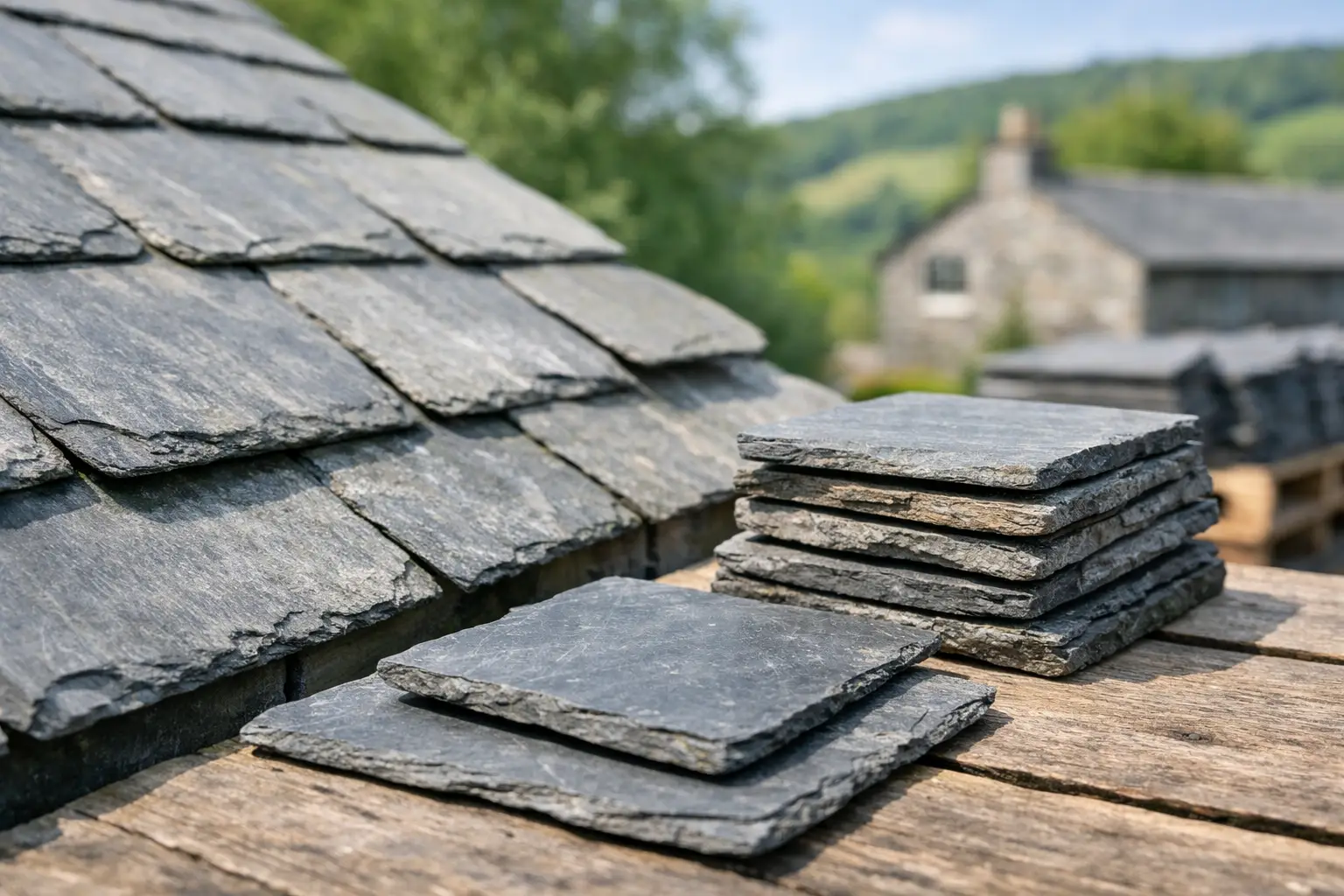
A roof repair can look wrong long before it leaks. A patch of newly quarried slate on a weathered Cumbrian roof may be technically sound but stand out in colour, texture and thickness. This guide to reclaimed Burlington slates explains what to look for when matching an existing roof, ordering materials and preparing for a lasting repair or restoration.
Why reclaimed Burlington slates are worth specifying
Burlington slate is valued for its distinctive blue-grey to green-grey appearance, close grain and proven performance on British roofs. It has long been used across the North of England and further afield, particularly on traditional properties where natural slate is central to the building’s character.
Reclaimed Burlington slates retain the softened surface and natural variation that only years of weathering can produce. For a localised repair, this often gives a more convincing match than new slate. It also makes practical sense: sound slates recovered from a roof can continue protecting another building for decades, reducing demand for newly extracted material.
That does not mean every reclaimed slate will suit every job. Stock can vary by source roof, size, thickness and weathering. A full reroof offers more scope to blend grades and dimensions, while a small repair needs a closer match. The right choice depends on the roof already in place, not simply the name on the slate.
Identify the slate before ordering
The term Burlington is sometimes used loosely for dark, fine-grained slates. Before ordering replacements, establish whether the existing roof is genuinely Burlington slate or another similar material, such as Welsh or Spanish slate. An experienced roofer can often identify likely origin from the slate’s colour, cleavage, edge character and thickness, but photographs alone are rarely enough for a precise match.
Take several samples from different areas of the roof if it is safe and appropriate to do so. Measure the exposed slates rather than relying on a single loose piece from a gutter or roof space. Record the length, width and thickness in millimetres, then note whether the slates are uniform or random width. Older roofs may have graduated courses, with larger, heavier slates at the eaves and smaller slates higher up.
Colour should be assessed in daylight. Burlington slate may appear blue-grey, grey-green or almost charcoal depending on moisture, aspect and age. A dry sample can look significantly lighter than a slate that has been through several wet winters. Surface texture matters just as much. A naturally weathered, lightly riven face will rarely blend with a smooth, freshly dressed alternative.
Check the roof pattern as well as the slate
A matching slate in the wrong course pattern will still look out of place. Measure the existing gauge, which is the vertical distance between batten lines or courses, and establish the headlap. Headlap is the overlap between a slate and the slate two courses above it. It is a key part of keeping wind-driven rain out of the roof.
Roof pitch, exposure and slate length all influence the required headlap. Do not copy an existing gauge automatically if the roof has failed because it was laid too openly. A competent roofer should confirm the correct fixing and lap arrangement for the roof’s pitch and conditions before any replacement slates are installed.
How reclaimed Burlington slates are assessed
Good reclaimed slate is not simply old slate. It should be inspected, sorted and supplied with its condition and practical use in mind. The most useful reclaimed stock has been carefully stripped, rather than damaged during demolition, and then graded to remove obviously cracked, delaminating or excessively worn pieces.
Start by looking at the slate’s edges and corners. Minor irregularity is normal on reclaimed material and can be part of its character. Deep chips that reduce the side lap or leave a vulnerable fixing area are more serious. Check for cracking around nail holes, as this is where a slate is most likely to fail during refixing.
Delamination is another concern. Slate forms in layers, but a quality roofing slate should not be splitting into thin sheets, flaking heavily or showing soft, friable areas. Tap testing can help an experienced handler identify a sound slate, although it should never be the sole test. The slate’s overall condition, thickness and history of use matter more than one quick check.
Existing nail holes must also be considered. Reclaimed slates can often be re-holed above the old fixing position, provided there is enough sound material and the revised hole position works with the required headlap. Avoid forcing a slate into a layout that leaves holes too close to an edge or creates an inadequate lap.
Match dimensions and thickness carefully
Dimensions are usually the first filter when sourcing reclaimed Burlington slates. A slate that is too short may not achieve the required headlap. One that is too narrow can compromise side lap and disrupt the bond. Thickness has a practical and visual role too: noticeably thicker replacements can sit proud of surrounding courses, while very thin slates may look weak beside heavier originals.
For straightforward repairs, it is sensible to order a small selection of closely matching slates rather than assume every piece will be identical. This gives the roofer options for blending colour and selecting the best fit around valleys, abutments and broken courses. If several slate sizes are present, sort them before work begins instead of trying to make decisions from a ladder.
A full roof project needs a different approach. Material may be specified by nominal size, random widths or by tonne, depending on the original roof and available stock. Allowance must be made for sorting, cuts, breakages and the slates needed at verges, valleys, hips and around rooflights. The usable coverage from a tonne varies with slate dimensions, thickness, headlap and wastage, so a weight-only estimate is not enough.
Fixings, battens and detailing matter
Even the best reclaimed slate will not perform properly on poor preparation. Check the condition and spacing of battens, the underlay arrangement, ventilation requirements and the condition of flashings before laying replacement slates. A repair is an opportunity to address the detail that caused the leak, rather than merely covering its visible symptom.
Fixings should suit the slate, roof exposure and specification. Copper nails are widely used for natural slate because of their long service life, while hooks can be useful for certain repair situations where access beneath the courses is restricted. The choice should not be made on convenience alone. Fixing type affects appearance, wind resistance and how future repairs can be carried out.
Pay close attention to details where slate meets another material. Lead soakers, flashings, valleys, ridge work and verge finishes often determine whether a repair remains watertight. A replacement slate inserted beside tired leadwork may solve nothing for long. On a period property, use detailing that respects the original roof while meeting the demands of its current condition.
When heritage considerations apply
Listed buildings and properties in conservation areas may require consent before roofing materials are changed, even where the work appears to be a like-for-like repair. This is especially relevant if a large area is being reroofed, the existing slate source is being changed, or the roof’s appearance will be altered through a different size, colour or pattern.
Reclaimed Burlington slates are often a strong choice for heritage work because they can preserve visual continuity. However, authenticity is more than selecting an old slate. Course layout, verge treatment, ridge details and the retention of sound original material all deserve consideration. Keep as much serviceable original slate as possible, then use reclaimed stock to make up the shortfall.
Questions to ask when buying reclaimed slate
Before placing an order, confirm the actual dimensions, approximate thickness range, colour variation and quantity available. Ask whether the slates have been sorted, whether they carry old holes, and whether the stock is suitable for repairs or a full reroof. For a large project, check that enough compatible material can be reserved, rather than relying on future availability.
Provide clear measurements, photographs and details of the roof pitch to the supplier. ReclaimedRoofSlates.com can help customers source reclaimed material alongside the associated battens, fixings, lead and roofing essentials, but accurate information at the outset is what produces a useful match.
Delivery and handling should be planned early. Natural slate is heavy, brittle at the edges and best stored securely on level ground. Make sure the delivery point can take the load and that the roofer has a safe route to move materials without unnecessary handling.
The best reclaimed Burlington slate repair is rarely the one with the newest-looking replacements. It is the one where sound materials, correct laps and careful detailing allow the repaired area to settle back into the roof – protecting the building without losing the character that made the original slate worth keeping.

